The Blood
A Look Under the Hood
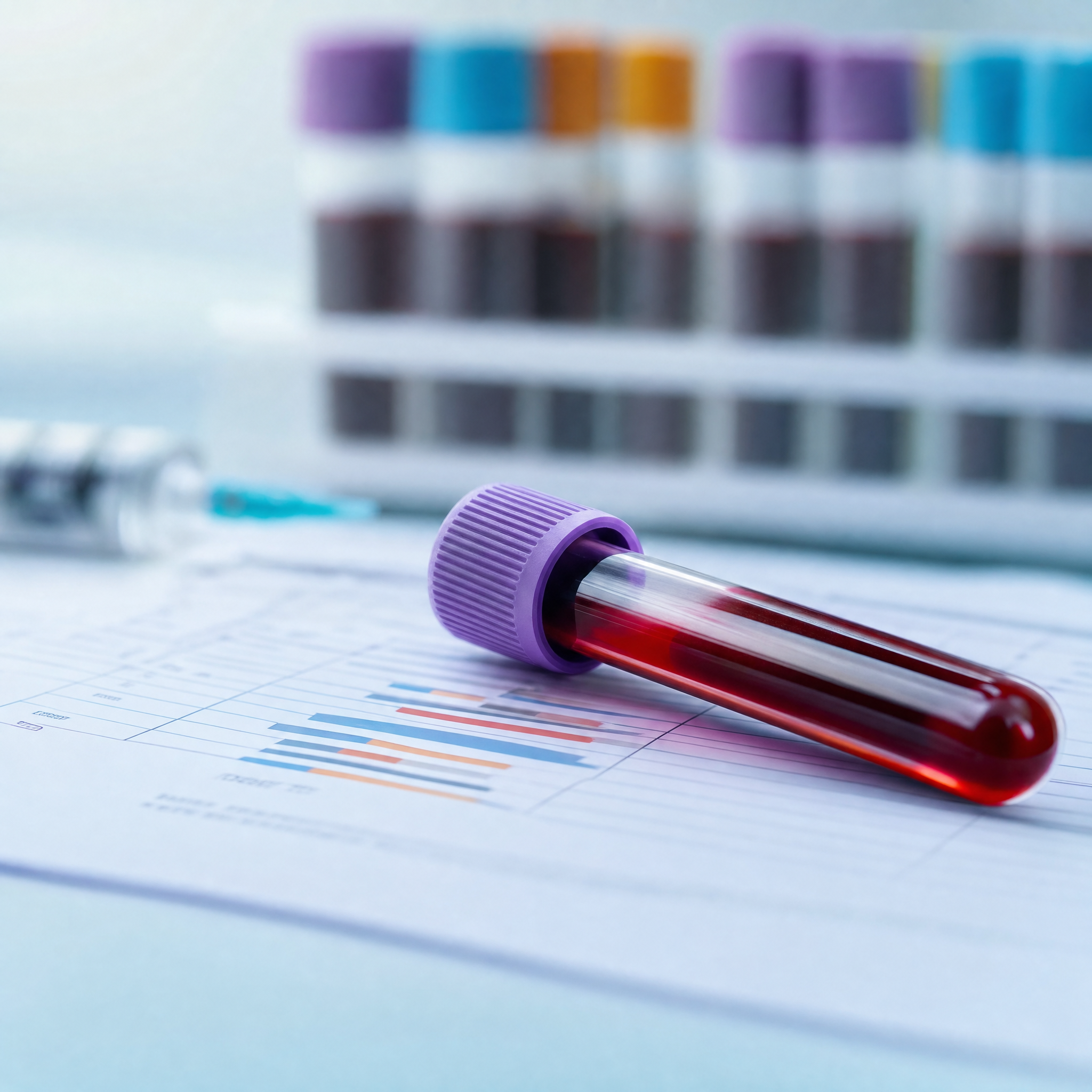
In the previous five parts of this series, we have extensively covered the "what" and "how" of sports nutrition: We laid the foundation of energy availability, filled up the carbohydrate tank for high performance, repaired the muscular chassis with proteins, and in Part 5, established fats as the essential directors of our cellular health.
But how do we know if all these measures are actually arriving where they are supposed to on a cellular level? Whether your oxygen transport is running optimally, or if your body is secretly struggling with empty stores? The answer is provided by a targeted look under the hood:
Blood diagnostics.
Many endurance athletes invest thousands of euros in aero wheels, carbon running shoes, and smart wearables, yet are completely in the dark about their internal performance parameters. In this part, we clarify which blood markers are truly relevant for you as an endurance athlete, provide valuable information, and show what a sensible testing setup looks like in practice.
1. The Oxygen Taxi: Hemoglobin, Hematocrit, and the Ferritin Trap
As a cyclist, triathlete, or runner, your performance is linearly coupled with your ability to transport oxygen to the working muscles. Here, three parameters are in focus:
Hemoglobin (Hb): The protein in your red blood cells that binds oxygen. A high value means more oxygen transport capacity.
Normal values: For men, the range is 14–18 g/dl; for women, 12–16 g/dl (Mairbäurl, 2013). Endurance athletes benefit from values solidly in the normal range, but shouldn't be surprised if they aren't scratching the upper limit (see hematocrit).
Hematocrit (Hct): Indicates the proportion of cellular components in the blood volume (how "thick" your blood is). Endurance training often increases blood plasma more than the number of red blood cells, which can lead to a slight, completely normal thinning of the blood—the so-called "sports anemia" (Mairbäurl, 2013).
Normal values: For men approx. 40–50%, for women approx. 36–46%. Many fit athletes tend to sit in the lower to middle normal range, which is actually advantageous for the flow properties of the blood.
Ferritin (Storage Iron): Here lies the biggest leverage—and the most common mistake. Hemoglobin can only be formed if iron is present. Ferritin is the marker for your iron stores (Peeling et al., 2008).
Many athletes have a "still normal" hemoglobin value but are riding around with a ferritin value completely in the basement (under 30–35 µg/L). This is called latent iron deficiency. The consequence: fatigue, potentially an inexplicably high heart rate during base endurance sessions, and above all, impaired recovery. Your ferritin level should ideally be stably above 50 µg/L (Peeling et al., 2008).
This brings us to one of the most important principles when interpreting blood values: A single value rarely provides a clear result; only a holistic view of several parameters gives a concrete picture. The relationship between ferritin and hemoglobin is a perfect example of this: Your hemoglobin (the oxygen transport) only drops when the ferritin (the storage) has already been massively depleted, often for months. If you only look at hemoglobin, you will recognize the problem much too late. That is exactly why the interpretation of blood values in sports should always be done alongside an expert (sports doctor or specialized coach).
2. The Pro-Hormonal Foundation: Vitamin D
Vitamin D is much more than a vitamin—it acts as a pro-hormone in the body. While it was previously known primarily for bone health (calcium metabolism), we now know that almost every cell—including skeletal muscle—has vitamin D receptors.
A deficiency impairs muscle strength, delays recovery, and makes your immune system collapse (Owens et al., 2018). Especially in our latitudes, almost all athletes who do not supplement show a deficiency between October and April. Target value: A level of 40 to 60 ng/ml (100–150 nmol/l) is considered optimal in competitive sports.
3. The Membrane Check: The HS-Omega-3-Index
In Part 5, we talked extensively about the omega-3 fatty acids EPA and DHA and their anti-inflammatory effects. The Omega-3 Index reveals whether your supplementation (with algal or fish oil) is sufficient and actually reaching your cells.
It measures the percentage of EPA and DHA out of the total fatty acids in the membrane of the red blood cells (von Schacky, 2014). If the index is too low, your cell membranes remain rigid, and your body stays stuck in an inflammatory mode. Target value: In endurance sports, we aim for an index of 8% to 11%. If your value is at the typical Western 4%, you should increase your intake of high-quality omega-3.
4. The "Hidden Champions": B12 and Silent Inflammation
A complete picture also requires looking at often-overlooked parameters that can act like "sand in the gears":
Vitamin B12 (Holo-Transcobalamin): Essential for blood formation, cell division, and a functioning nervous system. For all vegan and vegetarian athletes, this value is an absolute must, as B12 occurs almost exclusively in animal foods!
Do not have the standard serum B12 measured (it includes inactive analogues and is therefore inaccurate); instead, ask for the active marker Holo-TC (Herrmann et al., 2005).
An optimal Holo-TC value is > 50 pmol/L. Values between 35 and 50 pmol/L are considered a gray area (latent deficiency), and under 35 pmol/L as a manifest deficiency. A deficiency is primarily caused by a lack of intake (veganism/vegetarianism), but also by absorption disorders due to a stressed gut. Targeted supplementation with B12 is important (ideally via drops, sprays, or capsules as methylcobalamin) to quickly balance out the deficit.
hs-CRP (high-sensitivity C-reactive protein): A sensitive marker for silent, systemic inflammation in the body. A permanently elevated value (over 1 mg/L at rest) indicates that your body cannot process the training stress and is still "on fire."
This is also a good example of why multiple parameters should always be used for a meaningful interpretation. With hs-CRP, this becomes apparent in combination with the Omega-3 Index. If an athlete has a permanently elevated hs-CRP and at the same time a poor Omega-3 Index of 4%, these are clear signs: The body is producing massive inflammation due to hard training, but does not have the biochemical tools (EPA/DHA) to resolve this inflammation.
5. Wasted Money: The Overrated Parameters
General practitioners often measure standard values that, viewed in isolation, are completely useless or even misleading for a competitive athlete (Banfi et al., 2012):
Serum Iron (Iron in the blood): This value is subject to extreme daily fluctuations and is strongly influenced by what you ate shortly before the blood draw. It says absolutely nothing about your actual iron supply. Always determine ferritin (and transferrin, if necessary).
Creatine Kinase (CK): An enzyme that enters the blood during muscle damage. If you ran 15 kilometers or did heavy squats the day before the blood draw, your CK value will be extremely high. This often sends doctors without a sports medicine background into a panic—however, for you as an actively training athlete, an elevated CK value the day after an intense effort is completely normal and meaningless.
Serum Magnesium: The body keeps the magnesium level in the blood extremely constant, if necessary by pulling the mineral out of bones and muscles. A "normal" serum magnesium therefore does not mean that your cells are adequately supplied. Usable information can only be obtained here via more expensive whole blood analyses.
6. Coaching Practice: When and How Often to Test?
Okay, we now know what we need to measure. But how do we integrate this sensibly into everyday training?
The Baseline Check (1x per year): Do a comprehensive screening once a year—ideally during a phase of high training load. Why? We want to see how your system reacts under stress. If you do the test during the completely relaxed off-season, your body might have already self-regulated any deficits, and the picture will be distorted. Choose a time (e.g., the middle of your summer training block) that is representative of most of your training year. This way, you uncover weaknesses that are robbing you of performance under full load.
Re-Testing (every 3 to 4 months): Measuring blood values without any consequence makes little sense. If your baseline check was abnormal and you are counteracting it through supplementation or dietary changes, you need to readjust. The body needs about 3 to 4 months to sustainably replenish stores like iron or to completely rebuild the erythrocyte membrane (Omega-3 Index). A re-test after exactly this period will show you in black and white whether your dosage is correct or whether the supplement might not be absorbed by your gut at all.
If no abnormalities appeared and the training is going well, then an annual blood check is completely sufficient.
Conclusion
Just like your training and nutrition, your body shouldn't be a black box either. Smart, targeted blood diagnostics, interpreted alongside experts, takes the guesswork out of your recovery and performance development.
Forget mere snapshots like serum iron and focus on the hard facts: Storage iron (ferritin) and oxygen transport (Hb/Hct) in context, inflammation regulation via hs-CRP and the Omega-3 Index, the pro-hormonal foundation (Vitamin D), as well as the neurological foundation (Holo-TC). Work together with experts and make the analysis an active steering tool for your training.
References
Banfi, G., et al. (2012). Metabolic markers in sports medicine. Advances in Clinical Chemistry.
Herrmann, M., et al. (2005). Altered Vitamin B12 Status in Recreational Endurance Athletes. International Journal of Sport Nutrition and Exercise Metabolism.
Mairbäurl, H. (2013). Red blood cells in sports: effects of exercise and training on oxygen supply by red blood cells. Frontiers in Physiology.
Owens, D. J., et al. (2018). Vitamin D and the Athlete: Current Perspectives and New Challenges. Sports Medicine.
Peeling, P., et al. (2008). Iron status and the acute iron-regulatory response in athletes. Journal of Applied Physiology.
von Schacky, C. (2014). Omega-3 Index and Cardiovascular Health. Nutrients.