Context Beats Code
Why Generic AI can fail the "Time-Crunched" Athlete
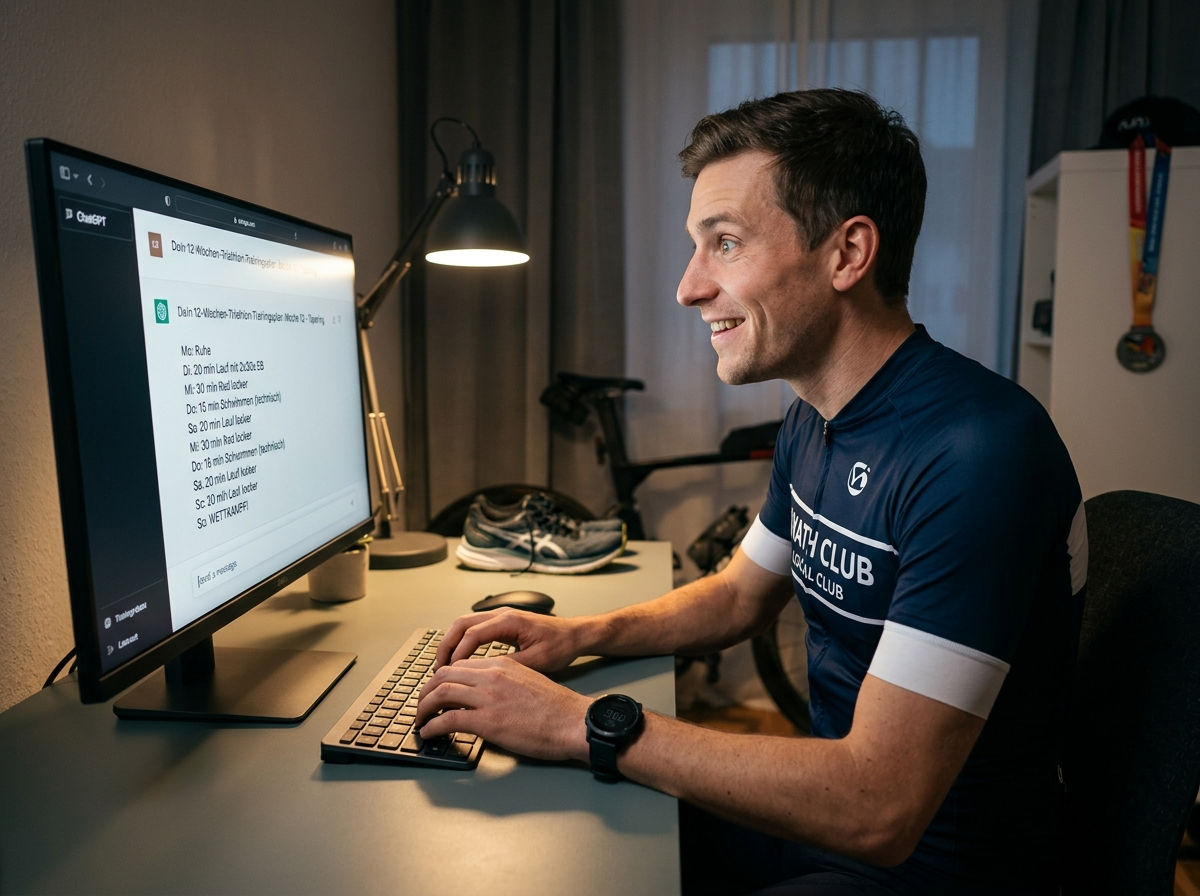
We live in fascinating times. Today, anyone can open ChatGPT or Gemini and type: "Write me a 12-week triathlon training plan." Within seconds, the system spits out a plan that looks structured and professional at first glance. Generic AI models are fantastic at summarizing the collective sports science knowledge of the internet.
However, the true test of a training plan isn't whether it pours scientific theory into a flawless PDF. The true test is whether that plan works in the reality of your daily life.
There is a very vivid example of this dangerous gap between generic AI and real coaching expertise: Tapering.
The Science
The goal of tapering is simple: to shed the fatigue accumulated over months while maintaining hard-earned fitness. This ensures you stand at the starting line on race day with maximum freshness.
If you ask science (and thus a generic AI), the formula for the perfect taper is clearly defined and backed by large-scale meta-analyses (e.g., Mujika & Padilla, 2003; Bosquet et al., 2007):
Start: 10 to 14 days before the race.
Volume: Reduction of weekly training volume by approximately 50%.
Intensity: Must be maintained to avoid losing stimuli for the muscles and cardiovascular system.
Frequency: The number of training sessions should ideally remain the same (or be reduced only minimally).
Sounds logical, right? For an athlete training 15 to 25 hours per week, this is absolutely correct. When a pro halves their volume, they are still training 7.5 to 12.5 hours—plenty of time to maintain physiological stimuli.
But what happens when an AI applies this textbook knowledge unfiltered to the "time-crunched age-grouper"?
The Reality
Let’s run the numbers for a typical endurance athlete. You work full-time, have a family, and train an efficient 3 to 4 hours per week, spread across 3 to 4 sessions. You don’t do "junk miles"; you train with focus and purpose.
If a generic AI strictly applies the scientific tapering rule, here is what happens: Your already compact volume of 3 to 4 hours is cut by 50%. You end up with 1.5 to 2 hours per week. Since the textbook says frequency should remain the same, the AI stubbornly divides this time across your usual 3 to 4 training days.
The result: You suddenly find training sessions of 20 to 30 minutes in your calendar, during which you are supposed to do, for example, 2 x 30 seconds at race pace.
From both a sports science and a practical perspective, this is an absolute disaster. No one gets changed for a 20-minute bike ride. Physiologically, such a short run or ride is hardly enough to properly ramp up the cardiovascular system or adequately stimulate metabolism. It simply ceases to be a meaningful stimulus.
Detraining Instead of Tapering
When the load drops so extremely (e.g., 3 x 20–30 minutes per week), exactly the opposite of what tapering is supposed to achieve happens. Your body doesn't just shed fatigue; it starts shutting down its systems entirely.
We are no longer talking about "peaking"; we are talking about detraining. Your muscle tension (tonus) disappears, your blood volume drops, and on day X, you don't feel explosive and fresh. Instead, you feel sluggish, "flat," and blocked. The engine has simply fallen asleep.
For a low-volume athlete, tapering must never be a blind halving of volume over two weeks. Often, a very short taper of 5 to 7 days is sufficient, where volume is perhaps reduced by only 20% to keep the tension in the body high. But you won't find that in a standard textbook—that is practical experience.
The Prompt Paradox
One could argue: "Then I’ll just change my prompt and tell the AI to consider my low baseline volume!"
True. With the perfect prompt, AI delivers fantastic results. But that’s exactly the problem: To give the AI the right instructions—to even know that a 50% cut two weeks before a race is counterproductive—you already need a significant amount of sports science knowledge and experience. And if you already have that knowledge, you probably don't need an AI to write the plan for you.
Conclusion: Context Beats Code
Intelligent training planning isn't defined by stubbornly reciting scientific studies. It’s defined by translating science into the individual context of the athlete.
Generic AI models know what’s in the textbook. But a true (digital) coach understands who you are, how much you train, and at what point a scientific rule does more harm than good in practice. That’s exactly why it’s not enough to just train with a text-based AI—you need a system that truly understands your sport, your data, and the reality of your daily life.
Sources & Further Reading
Bosquet, L., Montpetit, J., Arvisais, D., & Mujika, I. (2007). Effects of Tapering on Performance: A Meta-Analysis. Medicine and Science in Sports and Exercise, 39(8), 1358-1365. (The gold standard meta-analysis proving the 8–14 day window and 41–60% volume reduction).
Mujika, I., & Padilla, S. (2003). Scientific Bases for Precompetition Tapering Strategies. Medicine and Science in Sports and Exercise, 35(7), 1182-1187. (Foundational study on maintaining intensity while reducing volume).