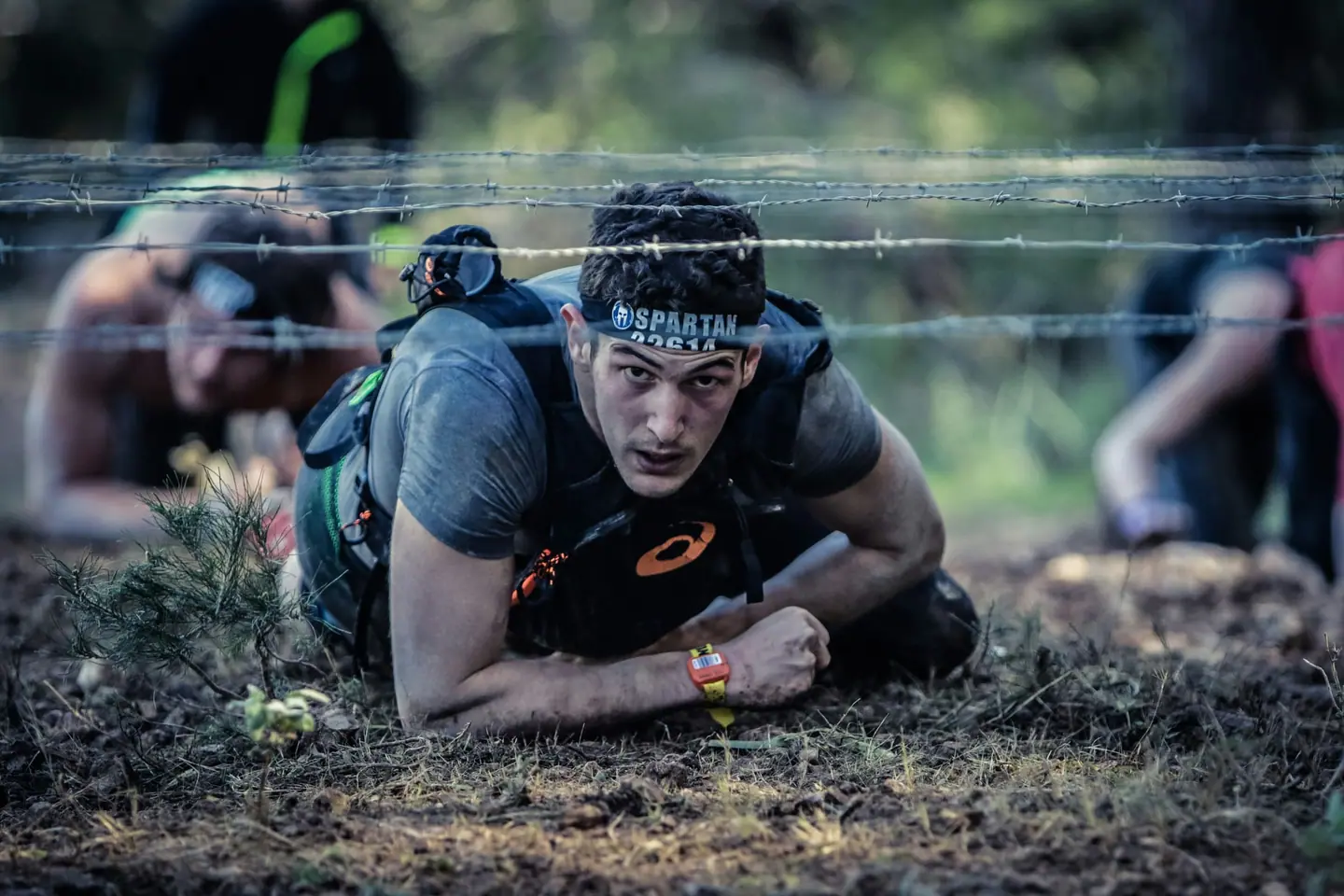
Spartan Race Zell am See-Kaprun.
The Spartan Beast at Zell am See-Kaprun is a half marathon that behaves like a mountain race with obstacles: 1,873 metres of climbing over a little more than 21 kilometres, stacked into two big ascents, with 30 obstacles on top. Preparing for it is not about speed but about climbing strength and about still being able to grip and carry after a 25 percent ramp.
Spartan Race Zell am See-Kaprun 2027: Course & Obstacles
The course starts on the Kaprun valley floor at around 765 metres and runs as a loop into the terrain below the Kitzsteinhorn glacier. The first long ascent begins as early as kilometre 1: 4.2 kilometres averaging 18 percent for 775 metres of gain, topping out at just over 1,500 metres.
After a long descent back toward the valley, the real business starts at kilometre 11. That climb runs 3.9 kilometres at an average of 25 percent, with ramps beyond 55 percent, for nearly 1,000 metres of gain: on the ski terrain above Kaprun this stops being running and becomes hiking for long stretches.
The profile confirms the character: only around 11 percent of the route is flat, while two thirds of it sits on steep ascent or descent. The 30 obstacles are spread across the whole loop, which means they systematically meet you where your legs are already loaded. The finish is back in the event area in the valley.
| Race | Distance | Obstacles |
|---|---|---|
| Beast | 21 km | 30 |
| Ultra | 50 km | 60 |
| Sprint | 5k | 20 |
| Super | 10k | 25 |
| Start | Length | Ø | Max. | Gain | Cat. |
|---|---|---|---|---|---|
| km 1 | 4.2 km | 18.4 % | 48.5 % | +775 m | Cat. 1 |
| km 8.8 | 0.6 km | 12.5 % | 29.6 % | +69 m | — |
| km 10.8 | 3.9 km | 25.2 % | 56.5 % | +978 m | HC |
Climb categories follow the road-cycling convention and rate the terrain itself (length and gradient) regardless of sport: Cat. 4 marks the easiest rated climbs, Cat. 1 the hardest, and HC (hors catégorie, “beyond categorization”) is reserved for the most brutal ascents. Short climbs below the Cat. 4 threshold stay unrated.
How to pace Spartan Race Zell am See-Kaprun.
Start under control
At close to 84 metres of climbing per kilometre, your running pace is not what decides this race; the way you meter your climbing strength is. The first ascent from kilometre 1 feels manageable on fresh legs, and that is exactly the trap: attack it in race mode and you pay for it twice ten kilometres later. Take it at a pace you could still hold at the end, and let people go.
Hold your rhythm
The long descent in between is the only genuine recovery of the loop. Use it actively, but do not wreck your quads on it: eccentric loading on steep downhill is why so many athletes come to a standstill on the final climb.
Spend what is left
The race is decided on the ascent from kilometre 11. An average of 25 percent means walking rather than running for almost everyone; finding a steady rhythm with short steps and hands on the thighs, having fuelled beforehand, costs far less time than charging in bursts and stopping. Factor in too that every obstacle on this section arrives with a high heart rate and empty arms.
Training plan for Spartan Race Zell am See-Kaprun: 12-week build

Build the base
For most age-group athletes the Beast here takes roughly three and a half to six and a half hours. It is a predominantly aerobic endurance effort, but one interrupted again and again by short, very intense spikes: every steep section and every obstacle pushes your heart rate well above threshold for a while, after which you have to gather yourself again while walking or running. That alternation, not the raw distance, is the demand.
Train race pace
Two phases decide the race. The first is the ascent from kilometre 1, because that is where the substance for the whole day is spent or preserved. The second is the closing climb from kilometre 11, which at an average of 25 percent is a pure strength-endurance task under accumulated fatigue.
Rehearse the course
Build your preparation accordingly. Uphill repetitions on steep ground, deliberately including fast hiking with active arm work, are the foundation; they prepare you for gradients where running was never an option. Add long sessions with 1,500 to 2,000 metres of climbing so your body knows the duration.
Arrive fresh
Two areas are routinely underrated. First, descending: train steep downhills specifically and under fatigue, or the long mid-course descent will cost you more than it returns. Second, grip strength and trunk work: monkey bars, heavy carries and pulling exercises belong in the plan, because here they are never asked of fresh arms but always after several hundred metres of climbing.

Courses
Download the Spartan Race Zell am See-Kaprun course as a GPX file for your watch or bike computer.
Let YOUB adapt your plan for Spartan Race Zell am See-Kaprun dynamically
Ben connects your goal, the course, current load, recovery, and calendar. Your plan stays pointed at race day even when real life is not perfectly plannable.
Everything about Spartan Race Zell am See-Kaprun.
How long is Spartan Race Zell am See-Kaprun?
Spartan Race Zell am See-Kaprun covers 21 km with 30 obstacles.
How much elevation gain does Spartan Race Zell am See-Kaprun have?
Spartan Race Zell am See-Kaprun has around 1,873 m of elevation gain over 21 km. That affects pacing, muscular load, and preparation for late-race sections.
What is the route profile of Spartan Race Zell am See-Kaprun?
Spartan Race Zell am See-Kaprun is classified as Mountainous, averaging 83.6 vertical metres per kilometre. 16% of the route is flat, 4% climbs moderately (2 to 6%) and 36% is steeper than 6%.
What climbs does Spartan Race Zell am See-Kaprun have?
The hardest climb of Spartan Race Zell am See-Kaprun starts at kilometre 10.8, runs for 3.9 km at an average of 25.2% and gains 978 metres. Cycling-convention rating: HC. 3 climbs are mapped in total.
Is Spartan Race Zell am See-Kaprun a loop course?
Yes, Spartan Race Zell am See-Kaprun is laid out as a loop: start and finish are in the same place.
Is there a GPX file for the Spartan Race Zell am See-Kaprun course?
Yes. The Spartan Race Zell am See-Kaprun course is on this page as a free GPX download — ready to import into Garmin, Wahoo, Komoot, Strava or any other app that reads GPX.
How should I prepare for Spartan Race Zell am See-Kaprun?
Spartan Race Zell am See-Kaprun asks for off-road running endurance and strength for the obstacles: grip, upper body and core. Combine off-road runs with strength and grip work; an adaptive plan places both so recovery and real life still count.
What pacing strategy works for Spartan Race Zell am See-Kaprun?
At Spartan Race Zell am See-Kaprun, you steer by how fresh you arrive at the obstacles, not by running pace. Run the stretches in between under control so grip and breathing last for the obstacles.
When does Spartan Race Zell am See-Kaprun take place?
Spartan Race Zell am See-Kaprun takes place on September 11, 2027.
Where does Spartan Race Zell am See-Kaprun take place?
Spartan Race Zell am See-Kaprun is held at Eventarea (Parkplatz) Baumbar, Sigmund-Thun-Straße 4, Kaprun.
Which distances does Spartan Race Zell am See-Kaprun offer?
Spartan Race Zell am See-Kaprun offers 4 distances — Beast: 21 km with 30 obstacles; Ultra: 50 km with 60 obstacles; Sprint: 5 km with 20 obstacles; Super: 10 km with 25 obstacles.
How do I register for Spartan Race Zell am See-Kaprun?
Registration runs through the organiser: de.spartan.com. YOUB shows you the course, elevation profile and training plan for your preparation.