2. WeinstadtTriathlon.
The Weinstadt Triathlon starts in an indoor pool and finishes between rows of houses: 300 metres in a 25-metre pool, three laps through the Weinstadt vineyards with two climbs each, and three run laps through the residential streets by the stadium. Across not quite 24 kilometres in total it gathers 289 metres of climbing, almost all of it on six short ramps.
No date has been announced for the next edition yet. The course, elevation and route profile are from the most recent edition.
Weinstadt Triathlon: Course, Elevation & Route Profile
The swim is 300 metres in the Neues Hallenbad Weinstadt, twelve lengths of a 25-metre pool. The start is at ten, with transition and the finish at the Weinstadt stadium in Endersbach.
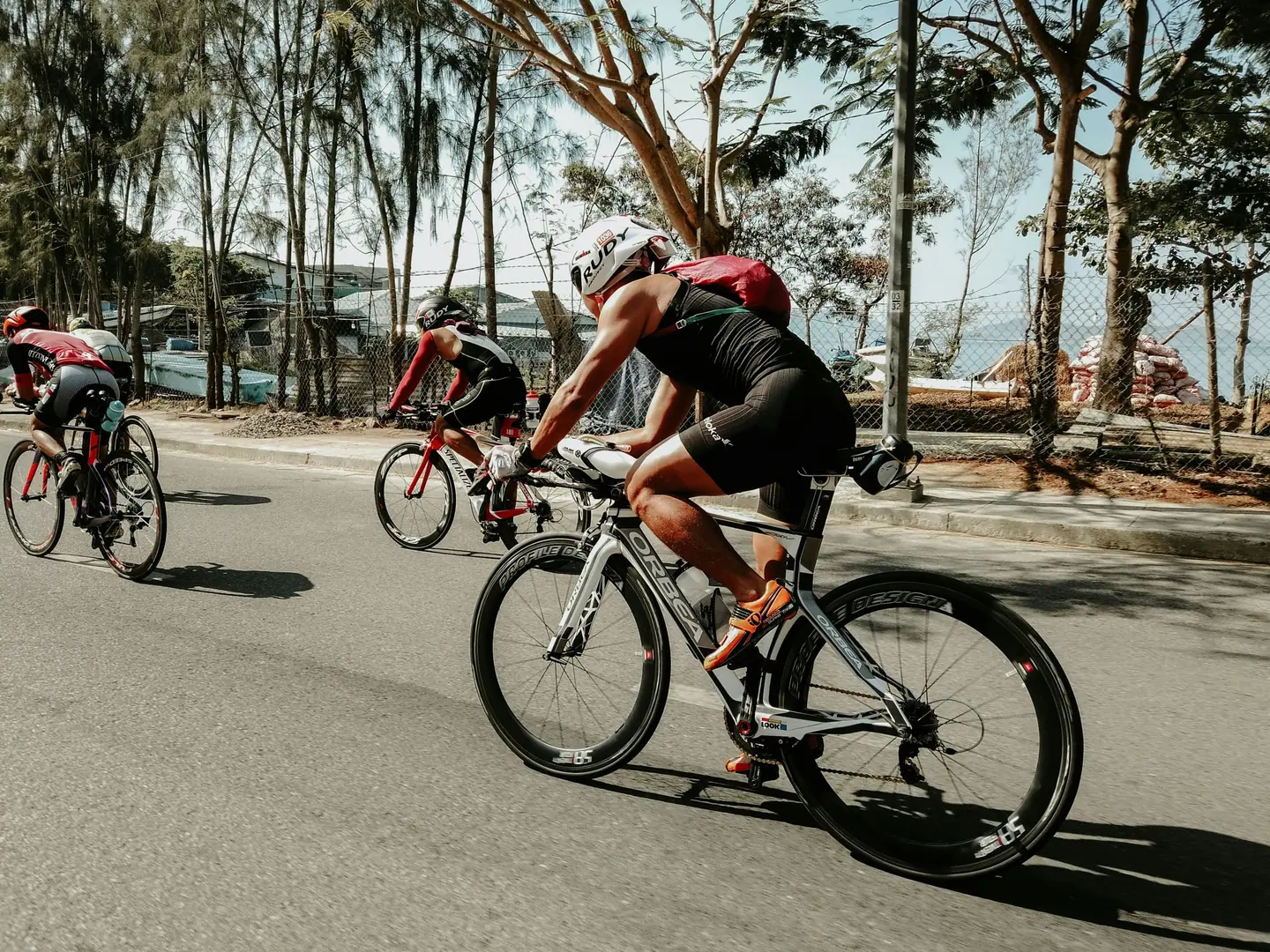
The bike consists of three laps of a good 6.2 kilometres through the vineyards above the town, and every lap repeats the same pattern: shortly after the start a 750-metre climb at around 3.2 per cent, immediately followed by a considerably shorter but steeper 330-metre ramp at a good 5.5 per cent with up to eight at the crest. Six times in all. The heights range from 243 to 303 metres, only about a fifth of the course is genuinely flat, and almost 44 per cent descends: what goes up comes back down on the same lap.
The run is three laps of roughly 1.5 kilometres through the quiet residential area right beside the stadium, entirely on asphalt. The elevation band is nine metres and there is no categorised climb, but only a good third of it is level: the constant small undulations and street corners between the houses feel more like a criterium than a running track. The race is staged for the second time by the town of Weinstadt together with SG Weinstadt, capped at 500 individual starters and 30 relays, and it counts towards the Triathlon REGIOCUP Stuttgart.
+259 m
+30 m
Bike course
18.7 km · +259 m| Start | Length | Ø | Max. | Gain | Cat. |
|---|---|---|---|---|---|
| km 1.5 | 0.8 km | 3.2 % | 5.6 % | +24 m | — |
| km 2.8 | 0.3 km | 5.5 % | 8.1 % | +18 m | — |
| km 7.5 | 0.8 km | 3.2 % | 5.7 % | +24 m | — |
| km 8.8 | 0.3 km | 5.7 % | 8 % | +18 m | — |
| km 13.5 | 0.8 km | 3.2 % | 5.7 % | +24 m | — |
| km 14.8 | 0.3 km | 5.7 % | 8 % | +18 m | — |
Climb categories follow the road-cycling convention and rate the terrain itself (length and gradient) regardless of sport: Cat. 4 marks the easiest rated climbs, Cat. 1 the hardest, and HC (hors catégorie, “beyond categorization”) is reserved for the most brutal ascents. Short climbs below the Cat. 4 threshold stay unrated.
Run course
4.6 km · +30 mHow to pace Weinstadt Triathlon.
Settle into the race
Twelve lengths in an indoor pool are over quickly, and a pool start invites you to swim them like a training set. Swim them briskly but with your breathing under control, because the first ramp on the bike comes after just a kilometre and a half, while your heart rate is still up from the water.
Spread the effort
What decides the race is how you handle the pair of climbs. A 750-metre pull at a good three per cent, immediately followed by 330 metres with up to eight, is exactly the combination that invites an attack, and it comes three times. Ride the long part seated and evenly, shift down early before the steep ramp and stay in the saddle there too. The 44 per cent of descending that follows is the recovery this course offers; use it to spin out rather than to push on.
Finish strong
The trap is the third bike lap. Since the course repeats exactly, the lap comparison is incorruptible: if lap three is markedly slower than lap one, the start was too hard, and the run course will not forgive it. It is flat, but with three laps, constant street corners and only a third of it genuinely level it offers no section in which to make anything good. Run the first lap to effort and lift only on the third.
Training plan for Weinstadt Triathlon: 12-week build
Build all three disciplines
For the Jedermann triathlon in Weinstadt, expect roughly 1:05 to 1:30 hours depending on your level. The demand is anything but even: only around 20 per cent of the bike course is level, six short ramps each force you into the anaerobic range, and with its constant small undulations and corners the run never holds a rhythm for long either.
Brick sessions
The six bike ramps and the first run lap decide it. Each ramp lasts only one to three minutes, but three repetitions of the pair add up to an anaerobic load that shows immediately over the 4.6 kilometres of running. That exact duration (short hard climbs with full recovery between them) should be familiar from training.
Practise transitions
The conditions are predictable and unusually mild for a triathlon. The swim is indoors, so no open water, no wetsuit and no sighting task, but eleven wall turns. Outside, the end of September in the Remstal vineyards brings cool mornings and a mild late morning; a ten o'clock start means the bike and run happen at pleasant temperatures but after a longer wait at the pool. The run course is asphalt throughout, while the bike uses vineyard roads with tight bends.
Arrive fresh
Three building blocks carry the preparation. First, hill intervals on the bike of one to three minutes on gradients between three and eight per cent, ridden in pairs with a descent between them, because the course repeats exactly that structure three times. Second, brick runs of ten minutes at race pace on undulating, twisty terrain rather than a straight course. Third, pool sessions with sets such as 6 times 50 metres at race effort, turn technique in a 25-metre pool included.

Courses
Download each leg of Weinstadt Triathlon as its own GPX file for your watch or bike computer.
Let YOUB adapt your plan for 2. WeinstadtTriathlon dynamically
Ben connects your goal, the course, current load, recovery, and calendar. Your plan stays pointed at race day even when real life is not perfectly plannable.
Everything about 2. WeinstadtTriathlon.
How long is Weinstadt Triathlon?
Weinstadt Triathlon is 23.6 km long. That distance shapes how much aerobic endurance, pace durability, and race-specific work belong in the training plan.
How much elevation gain does Weinstadt Triathlon have?
Weinstadt Triathlon has around 289 m of elevation gain over 23.6 km. That affects pacing, muscular load, and preparation for late-race sections.
What is the profile of the bike course at Weinstadt Triathlon?
The bike course at Weinstadt Triathlon is classified as Rolling, averaging 14.4 vertical metres per kilometre. 44% of the route is flat, 21% climbs moderately (2 to 6%) and 5% is steeper than 6%.
What climbs does the bike course at Weinstadt Triathlon have?
The hardest climb on the bike course at Weinstadt Triathlon starts at kilometre 1.5, runs for 0.8 km at an average of 3.2% and gains 24 metres. 6 climbs are mapped in total.
Is there a GPX file for the Weinstadt Triathlon course?
Yes. Each leg of Weinstadt Triathlon is on this page as its own free GPX download — ready to import into Garmin, Wahoo, Komoot, Strava or any other app that reads GPX.
How should I prepare for Weinstadt Triathlon?
Preparation for Weinstadt Triathlon should account for 23.6 km, 289 m of elevation gain, current training load, and available training time. An adaptive plan helps place key sessions without ignoring recovery and real life.
What pacing strategy works for Weinstadt Triathlon?
The pacing strategy for Weinstadt Triathlon should reflect 23.6 km, 289 m of elevation gain, and your current fitness. Start controlled and keep margin for sections where the profile or fatigue makes target pace harder.
When does 2. WeinstadtTriathlon 2026 next take place?
No date has been announced for the next edition yet. The most recent one was held on September 27, 2026.
Where does 2. WeinstadtTriathlon 2026 take place?
2. WeinstadtTriathlon 2026 takes place in Weinstadt, Germany.
Which distances does Weinstadt Triathlon offer?
Weinstadt Triathlon offers 2 distances — Jedermann-Triathlon: 23.6 km; Staffel: 23.6 km.
How do I register for Weinstadt Triathlon?
Registration runs through the organiser: sgweinstadt.de. YOUB shows you the course, elevation profile and training plan for your preparation.