OstseeMan Triathlon Glücksburg.
The long distance at the OstseeMan Triathlon Glücksburg opens with two Baltic laps off the spa beach, spends four flat bike laps in the Angeln countryside and closes with six running laps along the fjord. Every part of the day passes back through the same small park. What decides it is not the terrain but your pacing, and two kit bags you pack the evening before.
OstseeMan Triathlon Glücksburg 2027: Course, Elevation & Route Profile
The swim is a 1.9 km rectangle off the Glücksburg spa beach, swum clockwise with the orange buoys on your left and the yellow ones on your right. The long distance covers it twice, from a mass start and with no exit onto land between laps, so you are in salt water for the full 3.8 km in one go. From the beach you run into the Kurpark, where long and middle distance have separate transition areas and separate entrances.
Transitions run through bags rather than at the bike. The blue bag carries your cycling kit, the yellow one your running gear, and you change inside the transition tent. That makes T1 and T2 calmer and longer than a rack-side change, but it means every decision has to be made at bike check-in the day before: no bike can be dropped on race morning and nothing can be added later. There is no mechanical support on the bike course, so whatever breaks, you fix yourself.
The Kurpark is the hinge of the whole weekend, with start, transition, running lap and finish a few hundred metres apart. The fjord in front of it is a working waterway rather than a lake: training on the swim course outside the race is not possible because of ship traffic, and on race day DLRG lifeguards cover it from boats, kayaks and the shore.
+800 m
+293 m
Bike course
180 km · +800 m| Start | Length | Ø | Max. | Gain | Cat. |
|---|---|---|---|---|---|
| km 3.9 | 0.7 km | 4.3 % | 6.4 % | +28 m | — |
| km 48.8 | 0.7 km | 4.2 % | 6.4 % | +29 m | — |
| km 93.8 | 0.7 km | 4.3 % | 6.4 % | +28 m | — |
| km 138.7 | 0.7 km | 4.2 % | 6.4 % | +29 m | — |
Climb categories follow the road-cycling convention and rate the terrain itself (length and gradient) regardless of sport: Cat. 4 marks the easiest rated climbs, Cat. 1 the hardest, and HC (hors catégorie, “beyond categorization”) is reserved for the most brutal ascents. Short climbs below the Cat. 4 threshold stay unrated.
Run course
42.18 km · +293 m| Start | Length | Ø | Max. | Gain | Cat. |
|---|
Climb categories follow the road-cycling convention and rate the terrain itself (length and gradient) regardless of sport: Cat. 4 marks the easiest rated climbs, Cat. 1 the hardest, and HC (hors catégorie, “beyond categorization”) is reserved for the most brutal ascents. Short climbs below the Cat. 4 threshold stay unrated.
How to pace OstseeMan Triathlon Glücksburg.
Settle into the race
The way the day divides is clear: the swim takes the smallest share of the clock and carries the hardest edge. A swim cutoff exists, and in salt water with chop your pool times tell you very little. Swim by effort rather than by the pace you know from the pool, and expect sighting on the buoys to cost you rhythm.
Spread the effort
The bike decides whether you reach the marathon at all: a combined swim and bike cutoff ends your race before the run. At the same time the circuit is flat enough that it never forces a single recovery phase on you. Drafting is prohibited and the penalty box sits just before transition, so riding along in a bunch risks a time penalty exactly where it hurts most.
Finish strong
Even so, the race is settled on the six running laps. The classic trap is a bike split that felt effortless on flat ground and was still too high. Under-riding the bike honestly pays off more here than on a mountainous course, because nothing on this circuit slows the race down for you.
Training plan for OstseeMan Triathlon Glücksburg: 12-week build
Build all three disciplines
A full OstseeMan takes an age-group athlete somewhere around nine to fourteen hours depending on level, and none of those hours contains a recovery phase handed to you by the terrain. The demand is steady and aerobic throughout, and the limiters are fatigue resistance, carbohydrate intake and concentration.
Brick sessions
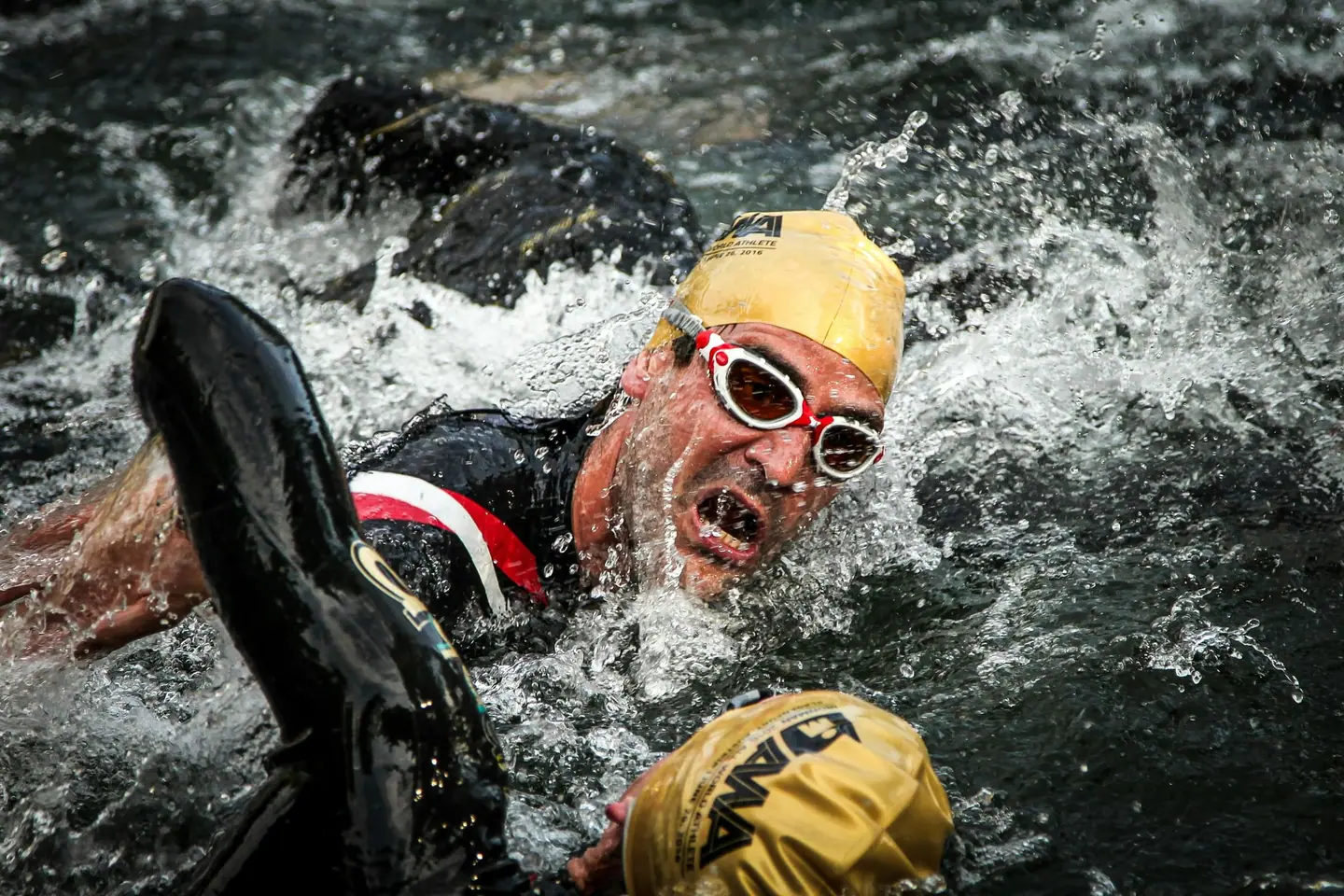
The part most often neglected in training is open water. Wetsuits are permitted up to a water temperature of 24.5 degrees, the Baltic off Glücksburg sits clearly below that even at the height of summer, and the final call comes shortly before the start. So plan on wearing the suit: shoulder mobility in neoprene, sighting strokes on buoys and several long sessions in the sea rather than the pool, so that salt water and chop are not a surprise on the day.
Practise transitions
The second focus is self-sufficiency. With no mechanical support on course, tube changes and punctures under time pressure belong in training, practised with the kit you will actually carry. Add the bag system to that: walk through your full T1 and T2 sequence once during the build, including the personal nutrition you can only collect at the official special needs point.
Arrive fresh
The third focus is the length itself. Long rides followed by running will do more for you here than any interval series, because this course never asks for spikes of intensity, only for the ability to hold a moderate one steady across a whole day while fuelling and attention fade.

Courses
Download each leg of OstseeMan Triathlon Glücksburg as its own GPX file for your watch or bike computer.
Let YOUB adapt your plan for OstseeMan Triathlon Glücksburg dynamically
Ben connects your goal, the course, current load, recovery, and calendar. Your plan stays pointed at race day even when real life is not perfectly plannable.
Everything about OstseeMan Triathlon Glücksburg.
How long is OstseeMan Triathlon Glücksburg?
OstseeMan Triathlon Glücksburg is 225.98 km long. That distance shapes how much aerobic endurance, pace durability, and race-specific work belong in the training plan.
How much elevation gain does OstseeMan Triathlon Glücksburg have?
OstseeMan Triathlon Glücksburg has around 1,093 m of elevation gain over 225.98 km. That affects pacing, muscular load, and preparation for late-race sections.
What is the profile of the bike course at OstseeMan Triathlon Glücksburg?
The bike course at OstseeMan Triathlon Glücksburg is classified as Flat, averaging 4.5 vertical metres per kilometre. 70% of the route is flat, 16% climbs moderately (2 to 6%) and 0% is steeper than 6%.
What climbs does the bike course at OstseeMan Triathlon Glücksburg have?
The hardest climb on the bike course at OstseeMan Triathlon Glücksburg starts at kilometre 48.8, runs for 0.7 km at an average of 4.2% and gains 29 metres. 4 climbs are mapped in total.
Is there a GPX file for the OstseeMan Triathlon Glücksburg course?
Yes. Each leg of OstseeMan Triathlon Glücksburg is on this page as its own free GPX download — ready to import into Garmin, Wahoo, Komoot, Strava or any other app that reads GPX.
How should I prepare for OstseeMan Triathlon Glücksburg?
Preparation for OstseeMan Triathlon Glücksburg should account for 225.98 km, 1,093 m of elevation gain, current training load, and available training time. An adaptive plan helps place key sessions without ignoring recovery and real life.
What pacing strategy works for OstseeMan Triathlon Glücksburg?
The pacing strategy for OstseeMan Triathlon Glücksburg should reflect 225.98 km, 1,093 m of elevation gain, and your current fitness. Start controlled and keep margin for sections where the profile or fatigue makes target pace harder.
When does OstseeMan Triathlon Glücksburg 2027 take place?
OstseeMan Triathlon Glücksburg 2027 takes place on August 1, 2027.
Where does OstseeMan Triathlon Glücksburg 2027 take place?
OstseeMan Triathlon Glücksburg 2027 takes place in Glücksburg, Germany.
Which distances does OstseeMan Triathlon Glücksburg offer?
OstseeMan Triathlon Glücksburg offers 5 distances — OstseeMan Langdistanz: 225.98 km; OstseeMan Langdistanz Staffel: 225.98 km; OstseeMan Mitteldistanz: 112.99 km; OstseeMan Mitteldistanz Staffel: 112.99 km; Glück in Sicht CharityRun: 5.5 km.
How do I register for OstseeMan Triathlon Glücksburg?
Registration runs through the organiser: ostseeman.de. YOUB shows you the course, elevation profile and training plan for your preparation.