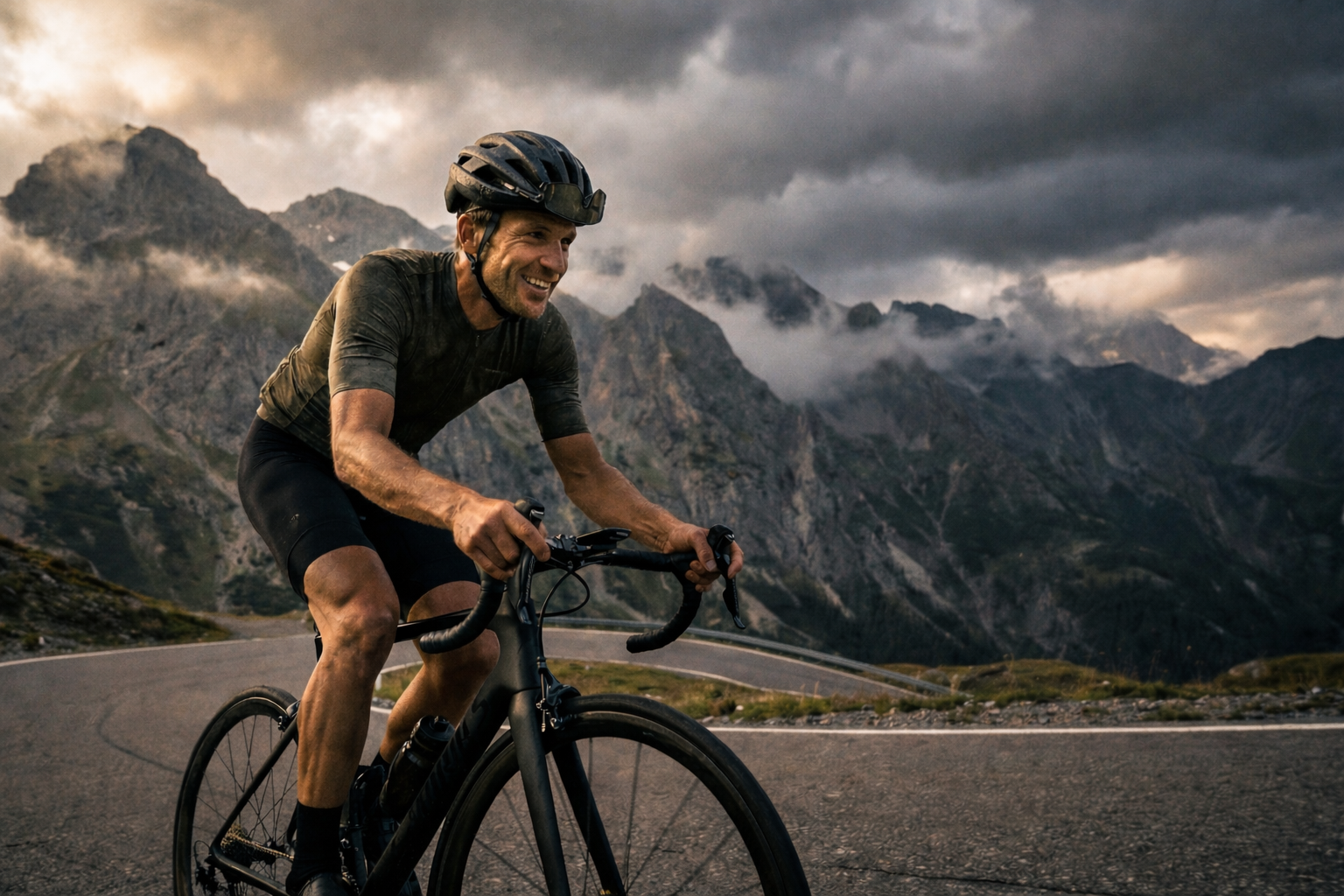
Triathlon training for beginners
For a first triathlon, a sprint distance is plenty, and the bike already in your garage will usually do. Start with two sessions per sport, six a week, many of them short. The biggest hurdle is nearly always the swim. If you can't front crawl 400 metres without stopping, spend time on that first and get someone to watch you from the poolside.
- Consistency first, then duration, and speed last
- One technique swim a week, ideally with feedback
- At least two open-water swims before your first race
Sprint and Olympic distance: less time, more intensity
At the short distances a small amount of volume goes a long way, and pace counts for more. A sprint is doable in eight weeks if you already run and ride. For the Olympic distance, allow more time and take the final 10 km seriously, because that's where the race is decided.
- One hard bike session and one hard run a week
- Short brick: 40 minutes on the bike, straight into a 10-minute run
- Practise transitions: wetsuit off, helmet on, shoes on
Middle distance: training for an IRONMAN 70.3
The middle distance is the favourite of people with full-time jobs: eight to twelve hours a week gets you through it well. The bike now takes up the biggest share, and how the half marathon goes depends on how you rode the 90 km. For a time under six hours, eight to ten hours a week is enough for many athletes. Going under five is a different project, and usually takes years of structured training rather than a few more weeks.
- Long ride with 2 × 20 minutes at race effort
- Long brick: 2 hours on the bike, 30-minute run at goal pace
- Rehearse your fueling on every long session
Full distance: months, not weeks
A full distance offers no shortcuts. Six to nine months of preparation is normal if the base is already there. The crux isn't one hard week; it's fitting all those hours around work, family and sleep for months on end. And when run volume climbs too fast, injury is a bigger risk than missing fitness.
- Bike volume as the foundation, with run volume kept under control
- Three or four big days with a long ride and a run back to back
- Practise 60 to 90 grams of carbohydrate per hour on the bike
How to split your hours between swim, bike and run
As a rule of thumb, about 20 percent of your time goes to the pool, 50 percent to the bike and 30 percent to running. That's a starting point. Weak swimmers add time in the water, and anyone who gets injured easily when running builds more of their fitness on the bike.
- Keep most sessions easy, even when they feel too easy
- No more than two or three hard sessions a week across all three sports
- One rest day a week stays in the plan
Brick workouts: running straight off the bike
For the first few minutes off the bike, your legs feel like someone else's. You can train that, and you don't need long runs to do it. A short run straight after a ride, once a week or every two weeks, is enough, moving to goal pace as the race gets closer.
- 10 to 20 minutes of running off the bike is usually enough
- Start the run gently and only settle into pace after a few minutes
- Leave your run shoes ready and practise the transition at the same time
Your targets: CSS, FTP and threshold pace
Each sport has its own threshold. In the pool, that's your critical swim speed, or CSS. Swim 400 metres flat out, rest, then swim 200 metres flat out. The difference between the two times, divided by two, is your CSS per 100 metres. For example, 7:00 and 3:10 give you 1:55 per 100 metres.
Tapering: the final weeks before the race
Three weeks out, the fitness is in the bank. Now it's about reaching the start line fresh. Seven to ten days of reduced volume is enough for sprint and Olympic races; for middle and full distance, allow two to three weeks. The intensity stays, and only the duration comes down.
An AI training plan: what YOUB takes on for triathlon
You tell the coach your race, your distance and your week in the chat. YOUB builds the plan across all three sports and reshuffles it when work or sleep gets in the way. Run and bike sessions land on Garmin, COROS, Suunto and Wahoo as structured workouts, and strength on Garmin and Suunto. Swim sessions don't go to any device. They sit in the app and calendar, with their targets.
- You enter your CSS yourself in settings, and YOUB uses it for swim targets and load
- YOUB detects your FTP and threshold pace from your sessions
- Apple Watch and Polar supply your activities but don't receive planned workouts
Triathlons to plan around
For each of these races, youb.app has the course, the elevation profile and the distances on offer. Pick your target and YOUB plans backwards from race day.
- DATEV Challenge Roth · Full distance, 226 km, 1,628 m of climbing
- IRONMAN European Championship Hamburg · Full distance, 226.2 km, 355 m of climbing
- IRONMAN 70.3 Kraichgau · Middle distance, 1,462 m of climbing
- IRONMAN 70.3 Zell am See-Kaprun · Middle distance, 1,119 m of climbing
- Austria Triathlon Podersdorf · From sprint to 226 km
- Trumer Triathlon · Obertrum, from sprint to middle distance
- Allgäu Triathlon · Immenstadt, sprint, Olympic and the 113.9 km Classic