
Running Economy
Or Why Felix Hasn’t Broken the 3-Hour Marathon Mark Yet?
TL;DR: A high VO2max won't do you much good in a marathon if your body burns through oxygen inefficiently—the real secret weapon for fast times is running economy. With targeted heavy strength training and plyometrics, you can measurably lower your "fuel consumption" while making yourself far more resilient to injuries.
_____
Whenever endurance performance comes up, one metric almost always takes center stage: VO2max (maximal oxygen uptake). It's widely considered the engine displacement of our bodies, and for many, the ultimate benchmark for measuring overall fitness.
According to his performance diagnostics, Felix boasts an impressiveVO2max of 74 ml/min/kg. On paper, an absolute dream score. So why has he failed twice to break the 3-hour marathon barrier? And how on earth does his good friend Hannes casually clock a 2:46h marathon with a VO2max of "only" 64 ml/min/kg?
What sets these two runners apart, where should their training priorities diverge, and most importantly: what can you take away from this for your own running?
The answer comes down to fuel efficiency: Running Economy (RE). Along with VO2max and lactate threshold, it forms the physiological triad of long-distance performance. Here’s the key difference: while your VO2max eventually hits an individual genetic ceiling, running economy can be refined and improved continuously for years.
What Exactly Is Running Economy?
Put simply, running economy measures how much energy or oxygen your body requires to maintain a given submaximal pace.
For a 4:00 min/km pace, Hannes needs significantly less oxygen than Felix. Oxygen means energy expenditure, and at race pace, energy primarily means carbohydrates. Hannes spares his glycogen stores considerably, burns far less "fuel" per kilometer, and can sustain that pace much longer than Felix.
1. Inside the Metabolism: How Is It Measured?
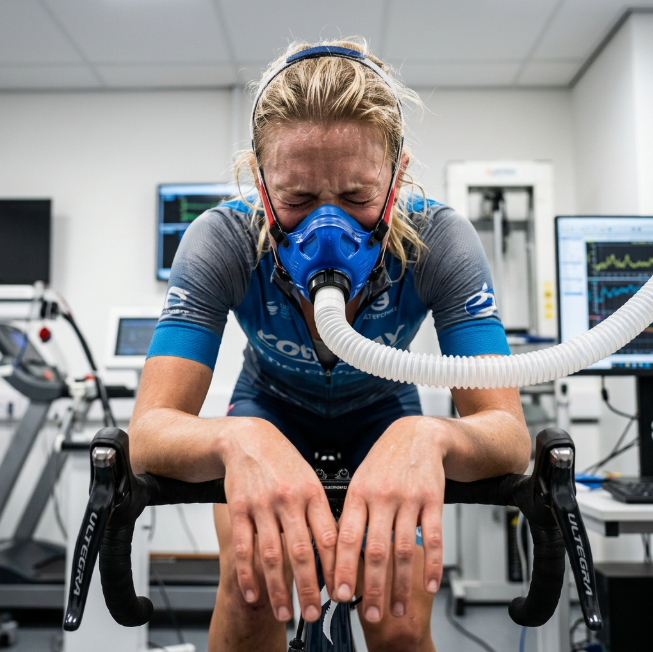
Running economy is traditionally measured in a lab on a treadmill using spiroergometry (breath gas analysis). The runner completes several stages of at least 3 minutes at a constant pace below their anaerobic threshold. An oxygen mask tracks oxygen uptake VO2 and carbon dioxide output VCO2.
From these readings, the standard metric for running economy (Oxygen Cost) is calculated: ml / kg / km
(How many milliliters of oxygen do you consume per kilogram of body weight to cover exactly one kilometer?)
Benchmark: What Is Average, and What Is World-Class?
Because oxygen consumption per kilometer remains remarkably stable across a wide range of speeds, ml/kg/km serves as an ideal comparative metric. The basic rule: the lower the number, the more efficient the runner.
Performance Level | Running Economy (ml O2/kg/km) |
World-Class / East African Elite | 150 – 175 |
Ambitious Competitive Runners | 180 – 195 |
Well-Trained Recreational Runners | 200 – 220 |
Beginners / Untrained | 230 – 260+ |
Record Numbers: Outlier athletes like Eliud Kipchoge or former half-marathon world record holder Zersenay Tadese have posted phenomenal marks around 150 to 160 ml/kg/km.
How Can You Actively Improve Running Economy?
Great—now we understand what separates elite runners from recreational athletes. But what do we actually do with this knowledge?
The best news: unlike VO2max, running economy is far less constrained by genetics. You can systematically train and refine it. Scientific meta-analyses (including Barnes & Kilding, Saunders et al.) highlight four primary levers you can pull:
Lifetime Mileage & Aerobic Base: Nothing sharpens intramuscular coordination quite like logging time on your feet. Over years of training, your central nervous system learns to fire only the exact muscle fibers required for forward propulsion, while allowing antagonist muscles to relax efficiently.
Heavy Strength Training & Plyometrics: Lifting heavy weights (80–90% of 1RM, low repetitions) paired with jump training (plyometrics) increases tendon stiffness. A stiffer Achilles tendon acts like a loaded spring upon ground contact, storing and returning substantial elastic energy. Studies show running economy gains of 2 to 8% in as little as 8 to 12 weeks.
Biomechanics – Natural Optimization Over Forced Changes: Running coaches used to dogmatically force every runner onto their forefoot—frequently causing overuse injuries and actually degrading running economy in the short term. The body naturally gravitates toward its most efficient movement pattern. Useful tweaks focus primarily on curbing heavy overstriding (landing far ahead of your center of mass) to reduce braking forces, often aided by a subtle cadence increase. (Tip: Inside our app, you can break down your running form directly with Ben to identify where you might be bleeding efficiency.)
Footwear: A fundamental rule of biomechanics states that adding 100 grams of weight to your foot worsens running economy by roughly 1 percent. Modern "super shoes" capitalize on this exact intersection of minimal weight, high-energy-return foams, and carbon-plate lever mechanics—a topic we'll explore thoroughly in our next post, as the hype around carbon shoes directly revolves around running economy.
What’s the Takeaway?
Running economy is all too often overlooked. Biomechanically, running is far more complex than cycling, where elites and hobbyists display fairly similar gross mechanical efficiencies due to the fixed circular pedal stroke.
As a runner, you'll gain vastly more by expanding your focus beyond VO2max, and threshold numbers to target your movement efficiency. If you've been avoiding the weight room, consider swapping a few weekly running kilometers for two targeted strength and plyometric sessions. You'll drop your metabolic cost on the road and build a significantly more injury-resilient frame. (Keep an eye out for our upcoming post covering strength-based injury prevention in the coming weeks!)
References & Further Reading
Barnes, K. R., & Kilding, A. E. (2015). Strategies to improve running economy. Sports Medicine, 45(1), 37–56.
(A comprehensive meta-analysis detailing effective training interventions for running economy, including heavy resistance and plyometric training.)
Saunders, P. U., Pyne, D. B., Telford, R. D., & Hawley, J. A. (2004). Factors affecting running economy in trained distance runners. Sports Medicine, 34(7), 465–485.
(Seminal review covering the physiological, biomechanical, and neuromuscular determinants of oxygen cost.)
Hoogkamer, W., Kipp, S., Frank, J. H., Farina, E. M., & Kram, R. (2018). A comparison of the energetic cost of running in marathon racing shoes. Sports Medicine, 48(4), 1009–1019.
(Groundbreaking investigation quantifying the energetic savings provided by modern carbon-plated marathon racing shoes.)
Frederick, E. C. (1984). Physiological and ergonomics factors in running shoes. Sports Shoes and Playing Surfaces, 79–88.
(The classic biomechanical reference demonstrating the direct relationship between added shoe mass and increased metabolic demand.)
Lucía, A., Esteve-Lanao, J., Oliván, J., Gómez-Gallego, F., San Juan, A. F., Santiago, C., Pérez, M., Chamorro-Viña, C., & Foster, C. (2006). Physiological characteristics of the best Eritrean runners—exceptionally high running economy. British Journal of Sports Medicine, 40(6), 530–534.
(Case study featuring Zersenay Tadese, documenting his exceptionally low oxygen cost of ~150 ml/kg/km.)
More from Physiology.

Cramp! – The Magnesium Myth ↗
Your calf locks up — time to reach for magnesium? It is not that simple. Learn why cramps in endurance sports often involve muscle fatigue, how fluids and electrolytes may contribute, and how to reduce your risk of cramping.
The VO2max ↗
More power for your legs

The Blood ↗
A Look Under the Hood