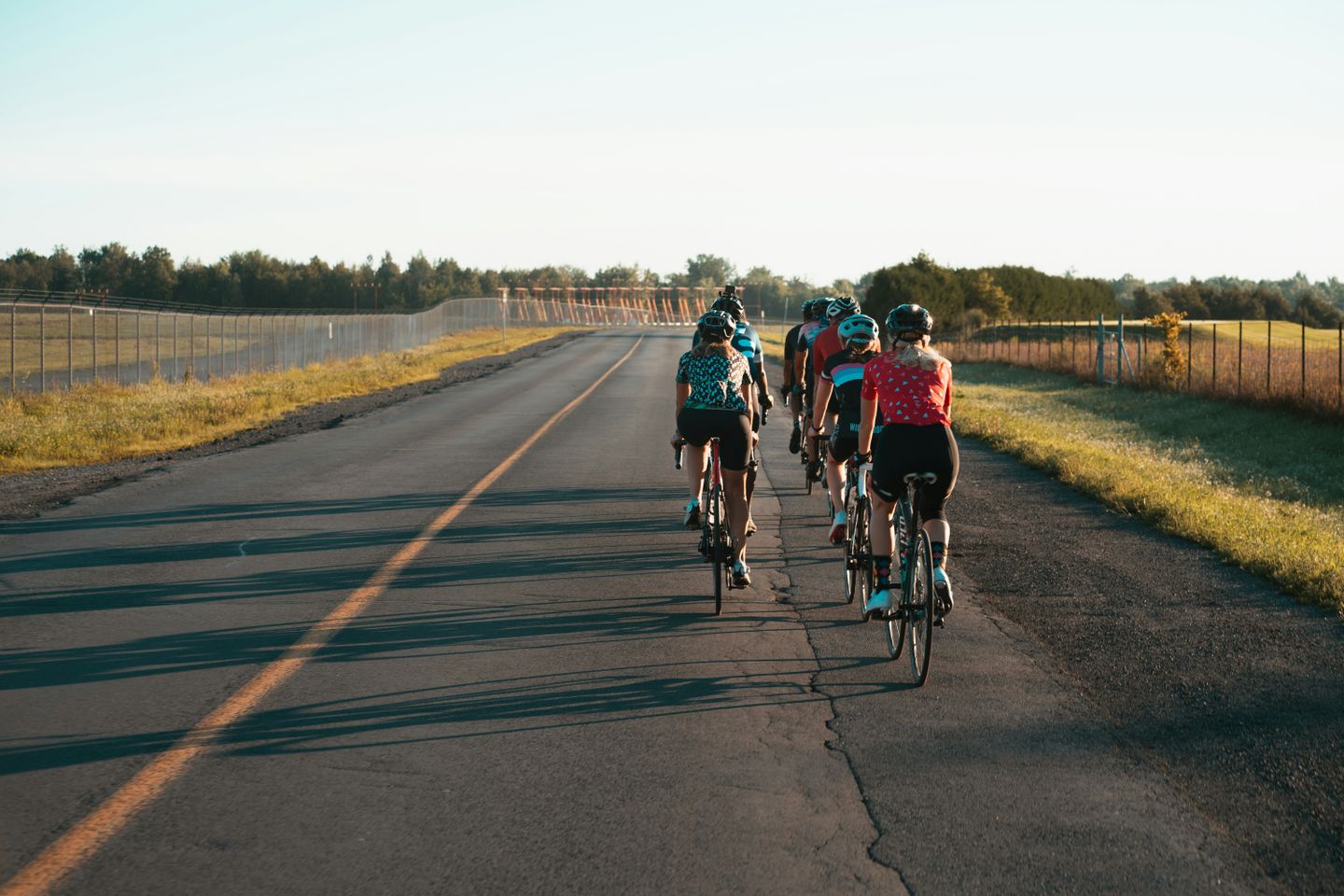
Zone 2 - Boring?!
Why should you really keep your base training easy instead of chasing down every rider who passes you? This post clearly explains which physiological signaling cascades—from new mitochondria and capillaries to a stronger heart—are triggered at 55–70% HRmax, and why this exact slow volume forms the foundation of your endurance performance.
TL;DR: Easy base training (55–70% HRmax) does far more than just improve fat metabolism. High training volume with low fatigue activates key signaling cascades that lead to more mitochondria, denser capillaries, better lactate clearance, a greater cardiac stroke volume, and more blood plasma. These exact profound adaptations form the indispensable foundation for true endurance performance—which is why it pays off to leave your ego behind on your next training ride.Every endurance athlete who has ever looked a bit more closely at training knows it.
We all know it: Base training should be easy.
And that’s why, of course, we all stick to it.
Always.
At least until the next training ride and an unnecessary overtake by an unknown cyclist who desperately needs to prove to their own ego who the stronger one is in this matchup.
Naturally, we can’t just let that slide. And besides, riding fast is way more fun anyway!
Everyone knows this scenario.
And for most of us, our own research into base training ended at the buzzword “optimizing fat metabolism” anyway. After this post, you’ll have a new, much more detailed picture of base training and its benefits. You’ll know exactly what happens in your body, which signaling cascades are triggered exclusively by easy pedaling, and through which mechanisms that leads to better endurance performance. And maybe next time, it’ll be a little easier to just let the other rider go and let your ego be. Human physiology is unbelievably complex. The deeper you dive, the more complicated—yet more fascinating—it becomes once you start grasping how everything connects. In this post, we’ve tried to capture that complexity while keeping it understandable, making the purpose of low intensity in base training tangible.
1. Mitochondria
Mitochondria are the “powerhouses” of your muscle cells. This is where all aerobic energy production takes place—both fat burning and lactate utilization. That makes them one of the most important factors for your endurance performance. Long base training triggers two central cellular signaling cascades in the predominantly used, endurance-oriented Type I muscle fibers:
Calcium signaling pathway (CaMK): Through thousands of repeated pedal strokes, calcium levels in the muscle cell remain elevated.
Energy stress (AMPK): Over the course of a multi-hour ride, the cell continuously consumes energy (ATP), which activates the energy sensor AMPK.
Both signaling pathways converge like two feeder roads onto the same main switch: the regulatory protein PGC-1α. Once PGC-1α is activated, mitochondrial biogenesis begins. More mitochondria are formed, and at the same time, existing ones increase in volume. In parallel, PGC-1α ramps up the production of MCT1 transporters—specialized transport proteins that shuttle lactate into the cell and to the mitochondria. This leads to a fascinating effect: through slow base training, you not only improve your fat metabolism, but paradoxically also massively expand your lactate clearance capacity for hard, fast races—at least in your Type I fibers. To train the MCT4 transporter, which is responsible for transporting lactate out of fast Type II fibers, you have to train intensely. More on that in the next blog post. Let’s remember: PGC-1α is the “master switch” for endurance-related adaptations.
2. Capillaries
Another decisive factor for your endurance performance is capillary density—meaning how tightly your muscles are woven with tiny blood vessels. The growth of new capillaries is called angiogenesis. The most important trigger for this is shear stress and the duration over which it acts:
During endurance training, your heart has to continuously pump blood through the working muscles over a long period of time.
This sustained blood flow creates mechanical friction along the inner walls of your blood vessels—known as shear stress.
This shear stress—combined with the mechanical pull of muscle contractions and local oxygen demand—activates the growth factor VEGF (Vascular Endothelial Growth Factor). VEGF gives the green light for new capillaries to form around your active Type I fibers.
This is where the strength of low-intensity training shines: because the load is so low, you barely fatigue and can maintain this stimulus for several hours. The simple mechanism: High duration = lots of shear stress = lots of VEGF = lots of new capillaries. The effect for you on the bike: a denser capillary network shortens diffusion distances. Oxygen and nutrients reach the muscle cell faster, and metabolic byproducts (like lactate later in a race or on a steep climb) can be cleared much more efficiently. By the way, this brings us full circle back to point 1: our master switch PGC-1α doesn’t just control the formation of new mitochondria—it also boosts the production of the growth factor VEGF.
3. Muscles
When riding easy, your body primarily recruits the aforementioned Type I muscle fibers (slow-twitch fibers). Their greatest strength: they fatigue extremely slowly and generate their energy almost entirely aerobically—meaning with the help of oxygen, primarily from metabolizing fats. Even so, glycolysis (energy production from carbohydrates) always runs in the background, as it is never completely shut off in the body. Since lactate is a natural product of glycolysis, blood lactate levels serve as a direct indicator of how active your carbohydrate metabolism currently is. That’s why your lactate level at base intensity should sit between 0.8 and a maximum of 1.5 mmol/l (even better, up to 1.2 mmol/l)—which is exactly what we saw during our lactate testing in November. (LINK to be added) The crucial point of riding slowly: there is so much oxygen available that the lactate produced isn’t a problem at all. On the contrary—it is shuttled via MCT1 transporters directly into the same or neighboring Type I fibers and from there into the mitochondria. There, the lactate is immediately metabolized aerobically again and converted into new energy (ATP). Production and clearance are in perfect balance.
4. The Heart
Through sustained volume load, your heart is heavily filled with blood for hours. This continuous stretching of the heart muscle activates the growth hormone IGF-1 and the so-called PI3K/Akt signaling pathway. This triggers healthy growth: the heart chambers expand over time, allowing your heart to pump significantly more blood through the body per beat (higher stroke volume). The result: with every single heartbeat, you transport more blood—and therefore more oxygen and nutrients—to your muscles. That’s also one of the main reasons why your heart rate continues to drop at the same pace as your fitness improves.
5. The Blood
Through long endurance training, your body increases its total blood volume—especially the liquid portion, blood plasma. This is triggered by two hormonal systems (RAAS and the hormone ADH), which signal the kidneys to retain water and sodium. At the same time, the liver produces more of the protein albumin, which binds this water within the bloodstream. More blood plasma not only improves oxygen transport to the muscles, but also enhances your cooling via sweating. Especially on long, hot summer rides, this is a real performance advantage.
6. Fat Metabolism
Last but not least, we naturally want to do justice to the well-known mechanism that base training improves fat metabolism. Because alongside all the other adaptations mentioned, that of course happens too: your muscles produce more specialized enzymes for fat burning—such as the enzyme CPT-1. It ensures that fatty acids can be shuttled directly into the mitochondria, where they are converted into energy.
The Foundation for True Endurance Performance
All of these factors—more mitochondria, denser capillaries, higher lactate clearance, greater stroke volume, more blood plasma, and more efficient fat metabolism—are absolutely crucial for high endurance performance. The secret of slow training at around 55–70% HRmax ultimately lies in volume: only because the intensity is so moderate can you sustain these stimuli for so long and repeat them often without overloading your body. You create a workload that makes all these profound adaptations possible in the first place. Of course, riding slow is only one side of the coin. What happens physiologically when we drive our heart rate up? In the next post, we’ll take a closer look at exactly that. Because that duel with the stranger during your training ride is actually an important building block for developing high endurance performance, too. Just as the mechanisms described here are primarily triggered by easy endurance training, other adaptations can only be set in motion through intense training. And those belong in a well-designed training program just as much as your easy base rides.
References
Egan, B., & Zierath, J. R. (2013). Exercise metabolism and the molecular regulation of skeletal muscle adaptation. Cell Metabolism, 17(2), 162–184.
Benton, C. R., Yoshida, Y., Lally, J., Han, X. X., Hatta, H., & Bonen, A. (2008). PGC-1α increases skeletal muscle lactate uptake by increasing the expression of MCT1 but not MCT2 or MCT4. Physiological Genomics, 35(1), 45–54.
Hellsten, Y., & Nyberg, M. (2015). Cardiovascular adaptations to exercise training. Comprehensive Physiology, 6(1), 1–32.
Arany, Z., Foo, S. Y., Ma, Y., Ruas, J. L., Bommi-Reddy, A., Girnun, G., ... & Spiegelman, B. M. (2008). HIF-independent regulation of VEGF and angiogenesis by the transcriptional coactivator PGC-1α. Nature, 451(7181), 1008–1012.
Brooks, G. A. (2018). The science and translation of lactate shuttle theory. Cell Metabolism, 27(4), 757–785.
McMullen, J. R., Shioi, T., Huang, W. Y., Zhang, L., Tarnavski, O., Bisping, E., ... & Izumo, S. (2004). The insulin-like growth factor 1 receptor induces physiological heart growth via the phosphoinositide 3-kinase (p110α) pathway. Journal of Biological Chemistry, 279(6), 4782–4793.
Convertino, V. A. (1991). Blood volume: its adaptation to endurance training. Medicine & Science in Sports & Exercise, 23(12), 1338–1348.
Jeppesen, J., & Kiens, B. (2012). Regulation and limitations to fatty acid oxidation during exercise. The Journal of Physiology, 590(5), 1059–1068.
More from Training.

Science Deep Dive: Zone 2 vs. HIIT - Which Training is the best? ↗
The question of optimal training intensity is one of the most frequently discussed topics. Not only in sports science – social media and the endurance bubble are full of it. We clarify whether endless hours in Zone 2, brutal HIIT intervals, or even maximal all-out sprints make you fitter.

Offseason ↗
The final race is over — and suddenly the goal that shaped your days is gone. How much time off do you need without losing your hard-earned fitness? Learn what happens to your body and mind during the offseason, and how to return to training with fresh motivation.
Running Economy ↗
Or Why Felix Hasn’t Broken the 3-Hour Marathon Mark Yet?