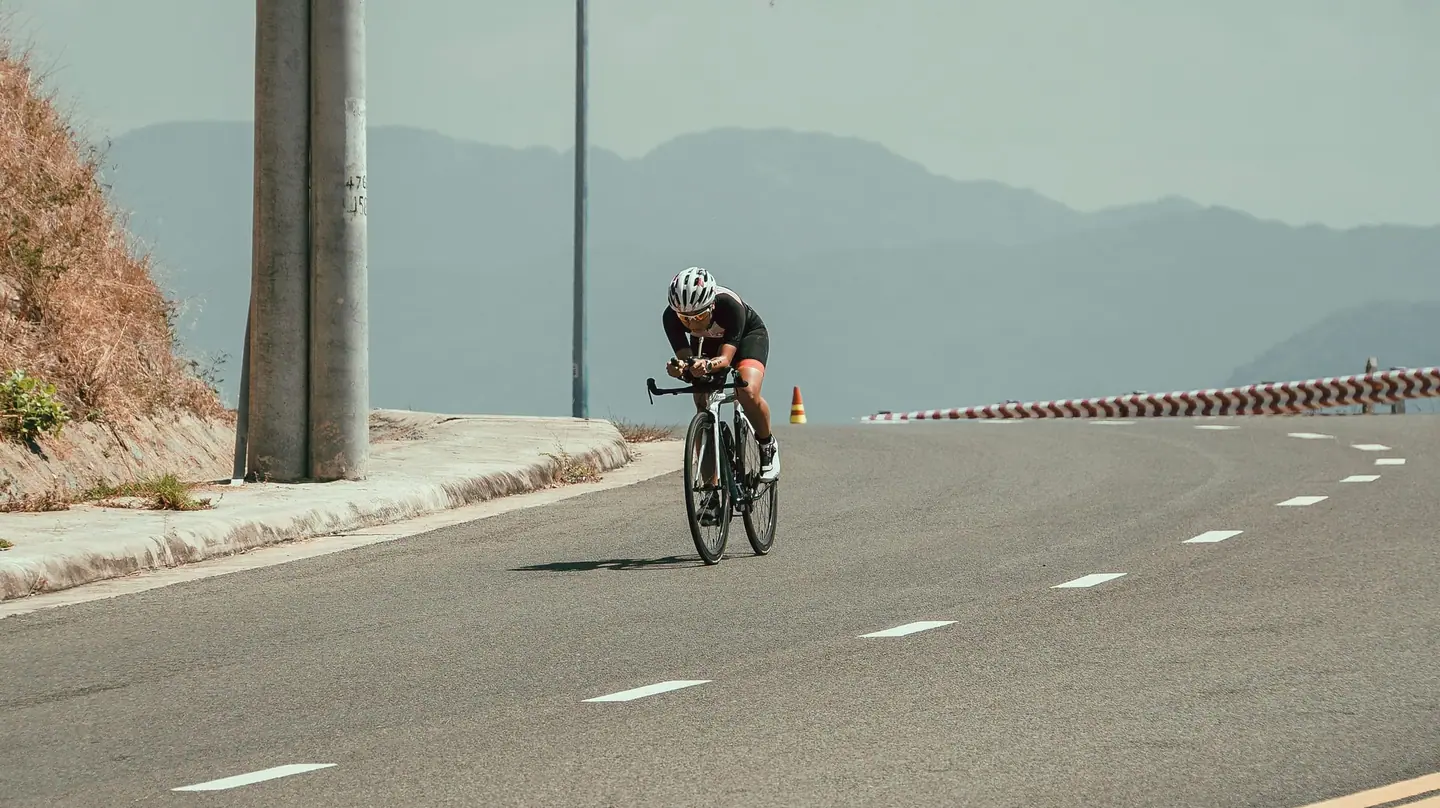
RST Lübeck Zeitfahrcup 2026 – Finale (Obernwohlde).
The finale of the RST Lübeck Time Trial Cup at Obernwohlde closes the series with a short, flat 9.0-kilometre individual time trial. The loop has no real climbs and finishes level with its start; over a good thirteen minutes it rewards a high, even output with no recovery phases.
No date has been announced for the next edition yet. The course, elevation and route profile are from the most recent edition.
RST Lübeck Time Trial Cup – Finale (Obernwohlde): Course, Route Profile & Map
The finale of the RST Lübeck time trial cup is held on a 9 km loop at Obernwohlde in the Stormarn district. It is the most compact course of the series and the most even-tempered: 42 metres of climbing, not a single registered ascent, start and finish at identical altitude. The profile drifts imperceptibly between 14 and 38 metres, roughly 60 percent of the lap is completely flat, and steep ground in either direction is entirely absent.
As the fifth and final round of the season, the finale lands on a Tuesday evening in early September with a 18:15 start, and with dusk arriving earlier it is one of the series' more atmospheric dates. As always the racing takes place on open public roads under normal traffic rules, scored in two classes: TT bikes, and road bikes without extensions. Entries go by email until the preceding Sunday and guest riders are welcome. For everyone who has collected points over the summer, the cup standings are settled here, and the short, fast lap guarantees that every second counts.
| Start | Length | Ø | Max. | Gain | Cat. |
|---|
Climb categories follow the road-cycling convention and rate the terrain itself (length and gradient) regardless of sport: Cat. 4 marks the easiest rated climbs, Cat. 1 the hardest, and HC (hors catégorie, “beyond categorization”) is reserved for the most brutal ascents. Short climbs below the Cat. 4 threshold stay unrated.
How to pace RST Lübeck Time Trial Cup – Finale (Obernwohlde).
Sit in early
Nine flat kilometres on a loop mean a short, intense effort close to threshold from start to finish. There are no categorised climbs, only gentle metre-high rolls over which you hold pressure evenly rather than sprinting and coasting. Because the course closes on itself the wind directions average out. Plan for a steadily constant output rather than big swings.
Ration your effort
It is decided by aerodynamic consistency across the full, short distance. The classic trap is starting too hard: over a time trial this length the temptation is to press flat out immediately, but an overcooked first kilometre costs more in the closing third than it yields.
Race the finale
Ease up to your target level over the first minutes and build through the final kilometres.
Training plan for RST Lübeck Time Trial Cup – Finale (Obernwohlde): 12-week build
Build endurance
Nine flat kilometres mean 12 to 16 minutes flat out, the shortest effort of the series and the most intense. The race is ridden well above threshold, close to maximal aerobic power; the anaerobic reserves are tapped from the gun and arrive at the line empty. It is the kind of effort where the legs protest after three minutes and the head has to carry the remaining ten.
Train the climbs
With no change of terrain anywhere, there is no marked decisive section; the decisive variable is the opening pace. The great danger on courses this short is the overcooked start: the first 90 seconds always feel too easy. Ride them under control, settle at the limit from minute three, and the final two kilometres can be spent entirely above sustainable intensity.
Ride race-specific
Preparation resembles a pursuit rider's program in miniature: intervals at maximal aerobic intensity (around five times 3 to 4 minutes with equal recoveries) form the core, supported by threshold work as the foundation and rehearsed race starts with a power cap to automate the opening.
Arrive fresh
Since the finale closes the cup season, the earlier rounds provide the best benchmarking; in the last week, short activation rides suffice. Equipment and position should be long settled by September: twelve minutes leaves no time to fix anything.

Courses
Download the RST Lübeck Time Trial Cup – Finale (Obernwohlde) course as a GPX file for your watch or bike computer.
Let YOUB adapt your plan for RST Lübeck Zeitfahrcup 2026 – Finale (Obernwohlde) dynamically
Ben connects your goal, the course, current load, recovery, and calendar. Your plan stays pointed at race day even when real life is not perfectly plannable.
Everything about RST Lübeck Zeitfahrcup 2026 – Finale (Obernwohlde).
How long is RST Lübeck Time Trial Cup – Finale (Obernwohlde)?
RST Lübeck Time Trial Cup – Finale (Obernwohlde) is 9 km long. That distance shapes how much aerobic endurance, pace durability, and race-specific work belong in the training plan.
How much elevation gain does RST Lübeck Time Trial Cup – Finale (Obernwohlde) have?
RST Lübeck Time Trial Cup – Finale (Obernwohlde) has around 42 m of elevation gain over 9 km. That affects pacing, muscular load, and preparation for late-race sections.
What is the route profile of RST Lübeck Time Trial Cup – Finale (Obernwohlde)?
RST Lübeck Time Trial Cup – Finale (Obernwohlde) is classified as Flat, averaging 4.7 vertical metres per kilometre. 61% of the route is flat, 19% climbs moderately (2 to 6%) and 0% is steeper than 6%.
Is RST Lübeck Time Trial Cup – Finale (Obernwohlde) a loop course?
Yes, RST Lübeck Time Trial Cup – Finale (Obernwohlde) is laid out as a loop: start and finish are in the same place.
Is there a GPX file for the RST Lübeck Time Trial Cup – Finale (Obernwohlde) course?
Yes. The RST Lübeck Time Trial Cup – Finale (Obernwohlde) course is on this page as a free GPX download — ready to import into Garmin, Wahoo, Komoot, Strava or any other app that reads GPX.
How should I prepare for RST Lübeck Time Trial Cup – Finale (Obernwohlde)?
Preparation for RST Lübeck Time Trial Cup – Finale (Obernwohlde) should account for 9 km, 42 m of elevation gain, current training load, and available training time. An adaptive plan helps place key sessions without ignoring recovery and real life.
What pacing strategy works for RST Lübeck Time Trial Cup – Finale (Obernwohlde)?
The pacing strategy for RST Lübeck Time Trial Cup – Finale (Obernwohlde) should reflect 9 km, 42 m of elevation gain, and your current fitness. Start controlled and keep margin for sections where the profile or fatigue makes target pace harder.
When does RST Lübeck Zeitfahrcup 2026 – Finale (Obernwohlde) next take place?
No date has been announced for the next edition yet. The most recent one was held on September 8, 2026.
Where does RST Lübeck Zeitfahrcup 2026 – Finale (Obernwohlde) take place?
RST Lübeck Zeitfahrcup 2026 – Finale (Obernwohlde) takes place in Obernwohlde, Germany.
How do I register for RST Lübeck Time Trial Cup – Finale (Obernwohlde)?
Registration runs through the organiser: rst-luebeck.de. YOUB shows you the course, elevation profile and training plan for your preparation.