Blutgeschmack, Erbrechen und Laktathusten?
The Truly Important Questions in Endurance Sports
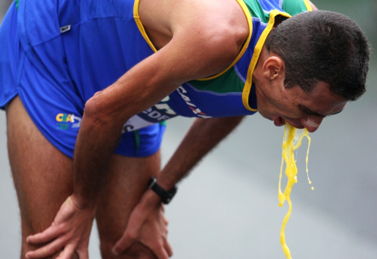
TL;DR: Discover the physiological causes of typical symptoms at your physical limit: metallic blood taste (pulmonary capillary micro-tears), vomiting (stomach ischemia and metabolic acidosis), and track cough (airway drying).
Sounds familiar? You’re running a 5K at absolute max effort, completing a time trial completely on the limit, or you’re right in the final rep of a hard VO2max interval: Suddenly, you notice a metallic taste of blood, your stomach rebels, or you just can’t stop coughing.
These are moments when the body shows reactions that might sound alarming to outsiders, but for you as an experienced endurance athlete, they are often just "everyday life on the edge." But what is actually happening physiologically? Is it dangerous, or just proof of true grit? Let's take a look at the three most extreme reactions your body has when you push yourself to the absolute limit.
1. The Taste of Blood: When the Lungs "Leak"
The final sprint, your heart rate is scratching its maximum, and you give it everything to the finish line. You're lying completely exhausted at the finish, gasping for air, and suddenly you notice that unmistakable metallic taste in your mouth—without having bitten your tongue.
The cause for this actually has to do with extreme gas exchange: the taste of blood originates directly in the lungs. During highly intensive efforts, your heart has to pump a massive amount of blood through the pulmonary circulation. As a result, the pressure in the pulmonary capillaries (the tiny blood vessels surrounding the alveoli) rises massively.
The physiology behind this is called "Stress Failure of Pulmonary Capillaries" (West & Mathieu-Costello, 1992). The membrane between the blood vessel and the alveolus is extremely thin to allow for the rapid diffusion of oxygen. Under the enormous pressure of exertion, tiny micro-tears can occur there, through which minimal amounts of red blood cells leak into the alveoli. The hemoglobin contained in them is iron-rich—and it is exactly this iron that you taste when it is transported upwards with the exhaled air and hits your taste receptors.
Context: As a rule, this is harmless and heals on its own within a very short time. It is simply a physiological sign that your cardiovascular system has been working at its absolute physical limit.
2. Vomiting After the Interval: Your Stomach's "Survival Mode"
It sounds paradoxical: You want to deliver maximum performance, but your body suddenly wants to throw off "ballast" and rids itself of the painstakingly ingested carbohydrates. The fact that athletes have to throw up after sprints or all-out tests primarily has two causes:
Splanchnic Ischemia: The higher the intensity, the more radically your body switches to prioritization. Blood is sent to where it is needed most urgently—the working muscles, the heart, and the brain. Blood flow to the gastrointestinal tract is reduced by up to 80% (Brouns & Beckers, 1993). Digestion effectively stops completely. If there is still undigested stomach content in the system, it is registered as a burden and disposed of via the fastest route.
Metabolic Acidosis: During efforts well above the anaerobic threshold, hydrogen ions (H+) accumulate. The pH value in the blood drops—you "acidify." The brain interprets this rapid drop as potential poisoning or a severe metabolic crisis and stimulates the vomiting center in the brainstem.
Interesting side effect: Stomach acid is highly acidic. When the body vomits and expels acid, it is also a (desperate) attempt by the system to balance the extremely acidic state of the entire body.
Coach's Tip: Pay meticulous attention to the timing of your last meal before hard sessions (read our blog ["Fueling Performance: Carbs are King"] for more on this). The more intense the planned training, the "emptier" the stomach should be to avoid this reaction.
3. Track Cough: When the Airways Dry Out
The so-called "track cough" usually occurs minutes after the effort. It is dry, persistent, and irritating. Although it is often referred to as "lactate cough" in German jargon, lactate only plays a minor role here.
The main cause is exercise-induced bronchoconstriction (EIB) due to dehydration of the airways (Anderson & Daviskas, 2000). During maximum effort, you inhale enormous volumes of air—up to 200 liters per minute—almost exclusively through your mouth. This air is usually significantly cooler and drier than the moist, warm climate deep inside your lungs.
This massive airflow rapidly extracts moisture from the mucous membranes of the bronchi. The cells shrink slightly, which releases inflammatory mediators and causes the smooth muscles of the airways to contract. The result is a strong, irritating cough with which the body tries to protect the airways from further drying out and to "cleanse" the lungs.
Conclusion for Your Training
These reactions are fascinating evidence of your body's adaptation and protection mechanisms. They show that you are capable of entering physiological border zones and proving your "grit." Nevertheless, such experiences should remain the exception—they are a sign for "race day" or specific key sessions.
At YOUB, we help you to specifically control these intensities. By analyzing your objective data and subjective feedback, we recognize when your body is ready for these "deep dives" and when controlled recovery brings more progress than training until you throw up.
Train hard, but train smart.
References
Anderson, S. D., & Daviskas, E. (2000). The mechanism of exercise-induced asthma is conditioning of the airways. Journal of Allergy and Clinical Immunology.
Brouns, F., & Beckers, E. (1993). Is the gut the limiting step in endurance performance? Sports Medicine.
West, J. B., & Mathieu-Costello, O. (1992). Stress failure of pulmonary capillaries: role in lung and heart disease. Lancet.
de Oliveira, E. P., et al. (2014). Gastrointestinal complaints during exercise: prevalence, etiology, and nutritional recommendations. Sports Medicine.