The VO2max
More power for your legs
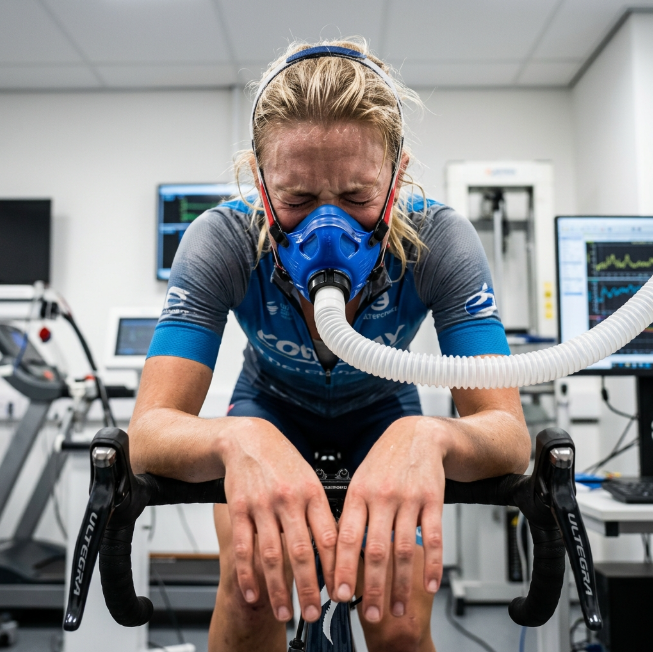
TL;DR: VO2max describes the maximum oxygen uptake during exercise and is considered a measure of an athlete's "engine displacement." This article explains how VO2max is defined via maximum cardiac output and muscular oxygen uptake, how you can calculate it yourself using field tests (Zwift ramp test, MAP, P30), and why laboratory spiroergometry remains the absolute gold standard.
Imagine this: You are riding the final minute of a brutal interval. Your legs are burning like fire, your lungs are screaming for air, and your heart rate is approaching its absolute maximum.
At this exact moment, you hit a physiological limit that is considered the holy grail of performance in endurance sports: your VO2max.
It is often referred to as the engine size of an endurance athlete. But what actually hides behind this value? How can it be determined? How accurate are the metrics on your sports watch, and do you absolutely need a professional performance diagnostics test—or is a straightforward field test enough?
In this article, we debunk the myths. We explain the physiology behind maximum oxygen uptake, show you how to calculate it using smart field tests, and discuss why a real laboratory measurement is still worth it.
1. What Is VO2max, Really?
VO2max describes the maximum amount of oxygen your body can utilize per minute under absolute, maximal exertion. It is expressed either as an absolute value in liters per minute (ml/min) or—crucial for performance on climbs—relative to body weight in {ml/kg/min}
Physiologically speaking, VO2max is based on the Fick equation and is the product of two main factors:
VO2max = Maximum Cardiac Output x Arteriovenous Oxygen Difference
Maximum Cardiac Output: How much blood can your heart pump through the body per minute? (Determined by stroke volume and heart rate).
Arteriovenous Oxygen Difference: How much oxygen can your muscles extract and process from this blood?
The primary limiting factors are the stroke volume of the heart and the oxygen-transport capacity of the blood (largely influenced by blood plasma volume and hemoglobin mass). Both variables can be significantly improved through targeted training. Additionally, factors such as sex, age, training status, and environmental conditions (e.g., heat or altitude) play an important role.
Summary: Although maximum oxygen uptake is genetically capped, it can be significantly increased in almost anyone through structured training.
2. Calculating VO2max via Field Tests: Ramp Test, MAP, and P30
To determine your VO2max without a laboratory, standardized ramp tests (such as those found on Zwift) have become well-established in practice. The principle is simple: after a warm-up, the required power increases in short intervals (e.g., by 20 watts every minute) until you literally cannot turn the pedals anymore.
Two crucial metrics for mathematically approximating your VO2max can be derived from this test:
MAP (Maximum Aerobic Power): The maximum aerobic power over the last complete minute of the test. If you terminate a stage early, the time is factored in proportionally (Example: finishing 380 watts, then quitting after 30 seconds into the 400-watt stage = a MAP of 390 watts). Note: Zwift automatically calculates your FTP as a flat 75% of this MAP.
P30 (Peak 30s Power): The maximum average power of the final 30 seconds of the test. The P30 is considered a particularly robust and protocol-independent indicator of maximum aerobic capacity.
Scientific Formulas in Comparison
Because MAP and P30 directly reflect your performance at the limit of oxygen uptake, you can convert them directly into your relative VO2max using established scientific formulas.
The following table shows the most common models applied to a 75 kg athlete with a MAP or P30 of 410 watts:
Model / Source | Calculated VO2max | Key Characteristics |
1. ACSM (American College of Sports Medicine) | 66.1 ml/kg/min | A very robust, universally established baseline. Can be calculated using either MAP or P30. |
2. Hawley & Noakes (1992) | 68.2 ml/kg/min | Validated specifically on trained cyclists. Accounts for efficiency and the energy cost of respiratory muscles in well-trained athletes. |
These estimations are surprisingly precise in practice because they are based on your actual maximal exertion. Nevertheless, they remain approximations, as individual gross efficiency (how efficiently your body converts oxygen into watts) varies slightly from athlete to athlete.
3. The Gold Standard in the Lab: Spiroergometry
Field tests provide excellent baseline values. However, they are based on statistical averages. In individual cases (n=1), this can match perfectly—or it can lead to significant deviations. The same applies to VO2max estimation via sports watches.
A sports watch has a distinct advantage and disadvantage: it has access to more data.
The Advantage: More data points can lead to a more tailored estimate.
The Disadvantage: Data is only as good as its quality, and training data is highly prone to errors (e.g., wrist-based heart rate inaccuracies, uncalibrated power meters, or lack of 100% maximal exertion).
If you feed your sports watch sufficient high-quality data, its calculation will likely be better than the extrapolation from the formulas above. Yet, the baseline for its calculation still relies on average values from a large population of athletes. The only way to determine your true, individual VO2max is through laboratory spiroergometry.
Why the Measurement System Matters
When choosing a lab, you should ensure that the measurement is performed using a mixing chamber system. With this setup, you breathe into a system that continuously measures your exact inhaled volume of oxygen (O2), exhaled carbon dioxide (CO2), and breathing frequency, mixing them in a chamber. Pure breath-by-breath systems (which measure every single breath) are significantly more prone to measurement errors, as even minor disruptions can skew the data.
The Rules for Clean Lab Data:
The Right Protocol: The final exhaustion phase should ideally last between 8 and 10 minutes (e.g., via ramps of +5 W every 6 seconds or +25 W every 30 seconds).
Avoid Long Stages: Traditional 3- to 5-minute stages are excellent for lactate diagnostics or determining efficiency. However, they are unsuited for VO2max determination, as local muscle fatigue often ends the test before the cardiorespiratory system is fully maxed out.
Smoothing the Data Noise: Because breathing data is naturally erratic, the sports science standard requires averaging the values over a 30-second window. Simply picking the highest peak of a single breath would artificially inflate the result. Only an oxygen consumption averaged over 30 seconds constitutes a scientifically sound VO2max.
Conclusion: Train Hard, but Train Smart
VO2max is the biological ceiling of your aerobic system—the size of your engine displacement. Field tests like the Zwift ramp test use mathematical formulas to provide fantastic, hassle-free baselines for your daily training.
If you want absolute precision and want to rule out measurement errors, book a laboratory spiroergometry test. Ultimately, remember that VO2max is just a data point. Granted, it is a highly important and meaningful one for endurance athletes. But at the end of the day, it's not the highest VO2max number that wins—it's the speed you can actually deliver to the road.
Bibliography
ACSM (2018). ACSM's Guidelines for Exercise Testing and Prescription. Wolters Kluwer.
Hawley, J. A., & Noakes, T. D. (1992). Peak power output predicts maximal oxygen uptake and performance time in trained cyclists. European Journal of Applied Physiology and Occupational Physiology.
Midgley, A. W., et al. (2007). Criteria for determination of maximal oxygen uptake: a systematic review. Sports Medicine.
Sitko, S., et al. (2020). Peak power output as a predictor of VO2max in competitive and recreational cyclists. Journal of Sports Sciences.