Pushing the Limits
The Conscious Quitter
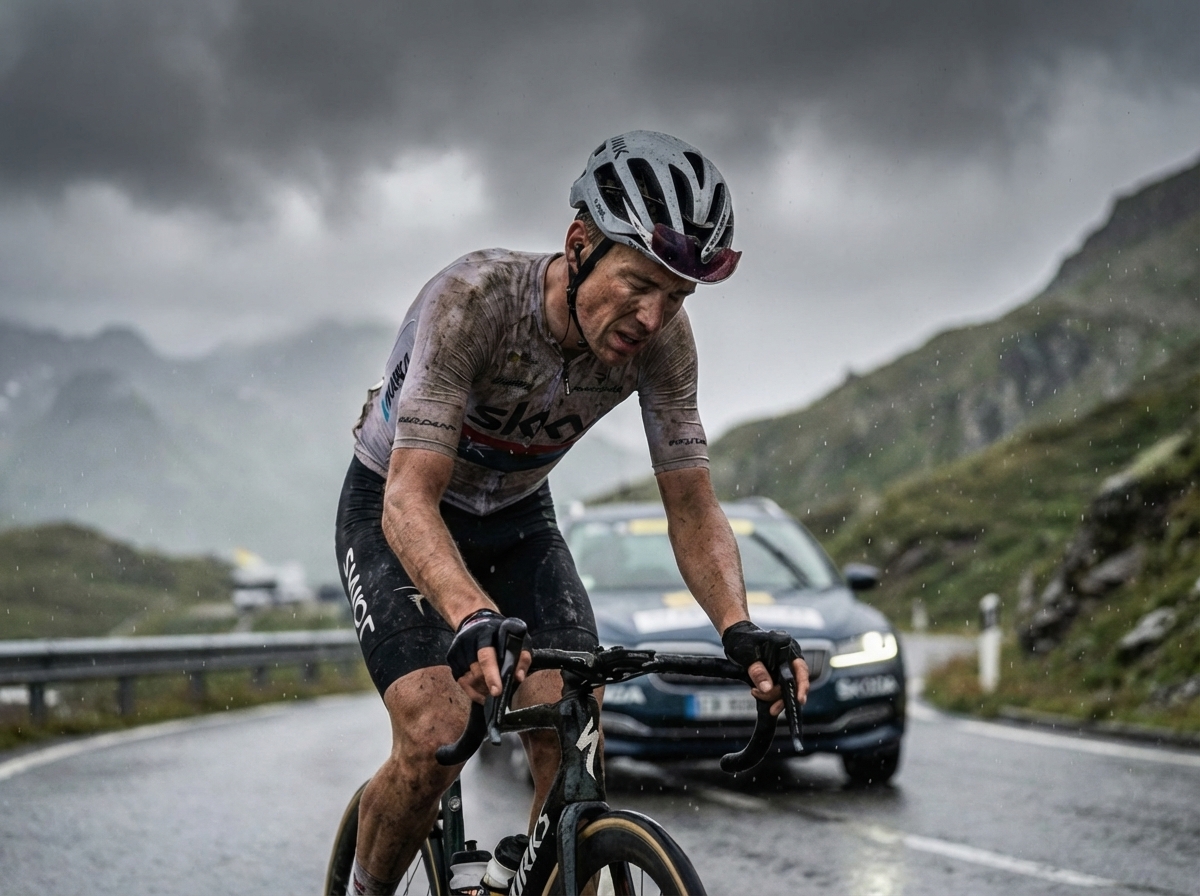
TL;DR: Part 3 of the fatigue series explores Samuel Marcora's Psychobiological Model, defining fatigue as a conscious cost-benefit decision (RPE vs. motivation) that can be influenced by mental training, caffeine, or visual cues.
In the second part of our series, we talked about Tim Noakes’ Central Governor – the theory that your brain acts like an unconscious safety regulator, slowing you down before you physically destroy yourself. But what if this limit isn’t defined so unconsciously after all?
Enter Samuel Marcora. While his Psychobiological Model shares similarities with Noakes, it differs in one crucial point: Marcora claims that fatigue is not an unconsciously controlled protective wall, but a conscious choice made by the athlete.
While Noakes views the brain as an subconscious regulator, Marcora takes it a step further. He postulates that we don't stop because the brain shuts us down for safety or because the muscle physically fails. We stop because we no longer want to keep going. It is the result of a simple cost-benefit analysis in our head. The two decisive variables are:
RPE (Rating of Perceived Exertion): How hard does it feel right now?
Motivation: How badly do I want to reach the goal, and what "price" am I willing to pay for it?
According to Marcora, fatigue is simply reaching one's maximum individual perception of effort. You don't abort an interval because your lactate level has reached exactly 12 mmol, but because the mental effort required to fight that feeling outweighs the subjective benefit (your motivation). In that exact moment, you become a "conscious quitter" – you make the conscious choice to ease off the pace or give up.
Smiling Makes You Faster
If fatigue primarily originates in the mind, it can also be manipulated there. Marcora backed this up with studies on the "facial feedback" effect. As early as 1988, Strack et al. showed that our facial expressions directly influence our emotions: participants who held a pen in their mouth in a way that forced an subconscious smile rated cartoons as significantly funnier than the control group.
Marcora transferred this concept to the lab: athletes rode to exhaustion while being shown smiling or sad faces subliminally (for milliseconds, meaning entirely below conscious awareness). The result was astonishing: the "smiling group" lasted an average of 10% longer. The reason is psychological: positive visual stimuli lower RPE. The exertion simply felt "less painful."
Perceived exertion is the all-important filter of our performance. It acts as an internal barometer, constantly checking whether the current physical effort is still proportional to the goal. As soon as this perception crosses a critical threshold, the mind signals that the costs are becoming too high. Anyone who learns to consciously manage this perception will inevitably push their physical limits.
Caffeine: The Miracle Weapon
The effects of caffeine also support Marcora's theory. The performance boost does not primarily come from a revved-up fat metabolism, but from the brain. As an adenosine antagonist, caffeine blocks the receptors that signal fatigue to our system. It quite literally dampens RPE. Therefore, caffeine doesn't directly alter the physical capacity of your muscles; instead, it shifts the boundary of your mental resilience upward.
In his book, Alex Hutchinson chooses an apt comparison: if you hold your finger in a flame, you pull it away reflexively. That is a protective instinct. The very essence of endurance sports is to override this instinct. It’s about holding your finger a little closer to the flame and keeping it there – not just for seconds, but for hours.
According to Marcora, "giving up" is not the moment your finger burns (physical failure). It is the moment you decide that the pain of the heat is no longer worth the victory. Training, therefore, doesn't just mean making your legs stronger; it means training your ability to delay the decision to "pull away."
Conclusion: From the Muscle to the Mind
In our three-part series, we went on a quest to find the true limit of human performance. The answer to why we have to stop or slow down during a race has shifted massively over the course of scientific history.
When we look at the three major theories, we see a fascinating evolution – away from pure physiology and toward psychology: from A.V. Hill’s classic Physiological Model (the body as a purely mechanical machine), to Tim Noakes’ Central Governor Model (the brain as an subconscious safety officer), all the way to Samuel Marcora’s Psychobiological Model (the athlete as a "conscious quitter" who decides based on perceived exertion).
The Takeaway for Your Training
What does this scientific journey mean for your daily practice?
It shows us that endurance performance rests on two inseparable pillars. On one side is your "engine" – your cardiovascular system, your muscles, your metabolism. You build this performance potential through physical training.
On the other side stands your "mind." It acts as a filter, deciding how much of that potential you can actually unlock on race day. Science makes it clear: when you reach the point in a race where your body screams "Stop!", you are physically far from finished. You have merely arrived at the point where your brain wants to test you.
If we want to push our boundaries, we cannot just focus on training our legs. We must learn to "hold our finger in the flame a little longer." It is about actively training how we deal with Rated Perceived Exertion (RPE) and recognizing the impulse to "give up" for what it truly is: a conscious decision. Because by doing so, we gain the power to push that moment further down the road. As Alex Hutchinson so accurately wrote: our limits are elastic – we hold the power to define where our boundaries lie.
The Cited Sources:
Strack, F., Martin, L. L., & Stepper, S. (1988). Inhibiting and facilitating conditions of the human smile: a nonobtrusive test of the facial feedback hypothesis. Journal of Personality and Social Psychology.
Blanchfield, A. W., Hardy, J., de Morree, H. M., Staton, W., & Marcora, S. M. (2014). Talking yourself out of exhaustion: the effects of self-talk on endurance performance. Medicine & Science in Sports & Exercise. (As well as the specific study on subliminal stimuli: Frontiers in Human Neuroscience, 2014).
Doherty, M., & Smith, P. M. (2005). Effects of caffeine ingestion on rating of perceived exertion during and after exercise: a meta-analysis. Scandinavian Journal of Medicine & Science in Sports.
Hutchinson, A. (2018). Endure: Mind, Body, and the Curiously Elastic Limits of Human Performance. William Collins.