Pushing the Limits
The Central Governor
TL;DR: Part 2 of the fatigue series introduces Tim Noakes' Central Governor Model, which views fatigue as a subconscious protective measure by the brain to prevent physical collapse, explaining phenomena like the end-spurt effect.
In the first part of our series, we explored A.V. Hill's classic physiological model. It describes the body like a machine: when oxygen runs out or lactic acid floods the muscle, it's over. But anyone who has ever seen a completely exhausted runner suddenly fly past everyone in a final sprint quickly realizes: this cannot be explained in purely mechanical terms.
To close these logical gaps, sports scientist Dr. Tim Noakes introduced a new approach: the Central Governor Model (CGM).
According to Noakes, fatigue is not a physical failure of the muscles, but an anticipatory regulation by the brain. The ultimate goal of the central nervous system is to ensure that a total biological breakdown never occurs. In this model, human performance is not limited by a failure of homeostasis in key organs like skeletal muscle, but is rather regulated in an anticipatory manner by the central nervous system. The goal is to specifically ensure that such a biological failure—at least in healthy individuals—can never happen.
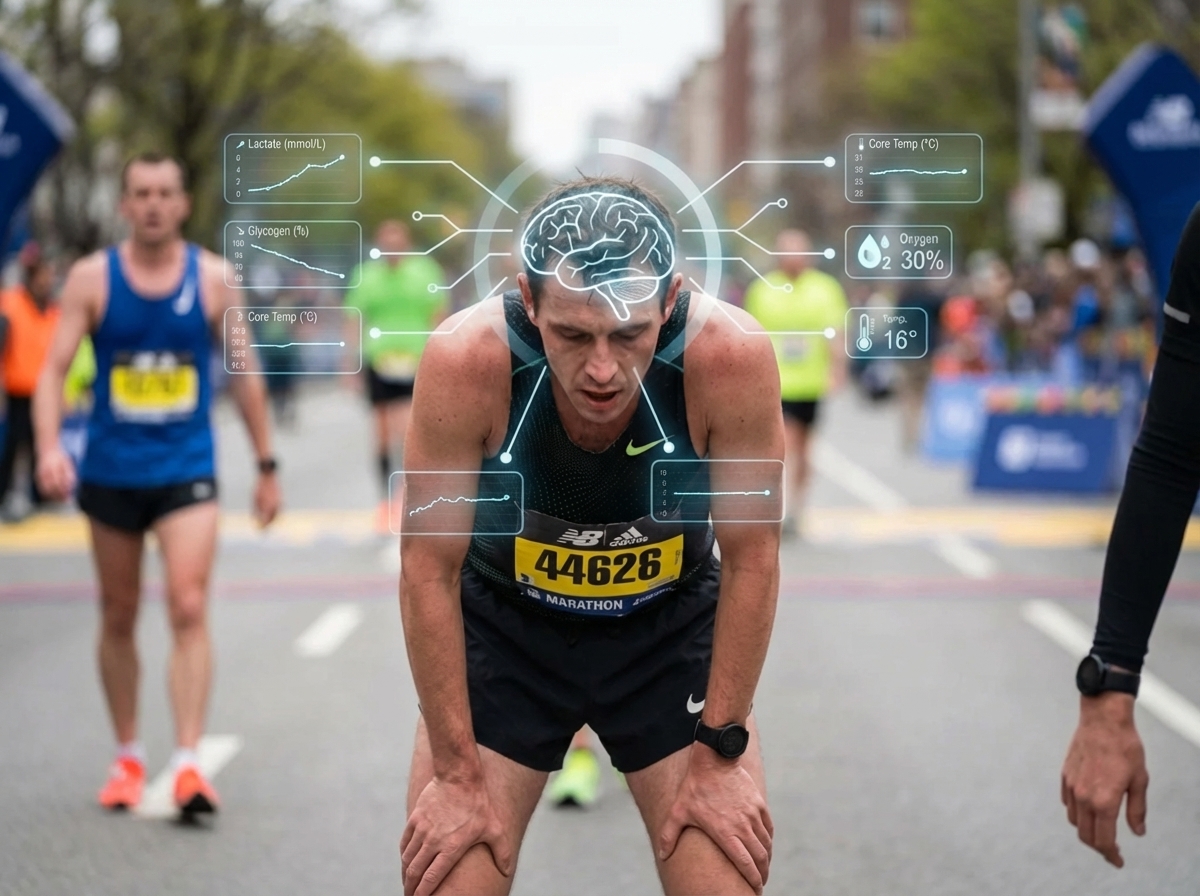
The brain acts as a kind of "safety officer." It constantly scans countless data streams, such as heart rate and oxygen saturation, glycogen levels and body temperature, or hydration status. Before a true system crash occurs, the brain pulls the emergency brake. It reduces the recruitment of muscle fibers and sends us signals that we perceive as agony. According to Noakes, the burning sensation in the thighs and shortness of breath are therefore not signs of physical failure, but an emotion generated by the brain that forces us to slow down—long before we are truly physiologically exhausted.
The Illusion of Exhaustion and the Phenomenon of the Final Sprint
Based on this theory, any exertion always begins at an intensity that the brain has determined can be maintained, taking into account all available variables (such as duration, power output, temperature, etc.). As a result, virtually all forms of physical exertion are submaximal. Studies show that even during supposedly maximal exertion, not all motor units of the musculature are ever activated simultaneously (Amann et al., 2006). There is always some sort of safety reserve.
A Mental Decision: Who Wins and Who Loses?
Assuming that fatigue is primarily regulated in the brain and that the athlete's physiology dictates performance to a lesser extent, some fascinating conclusions can be drawn. It would mean that in the event of a tight final sprint, the loser's brain accepts second place and decides against attacking for the lead one more time. Just as a single athlete must "decide" to win, the remaining athletes must decide the opposite. It is possible that the athletes who do not win make the conscious or unconscious decision not to win before the race even begins. The brain then merely uses the symptoms of "fatigue" to justify this decision. Ultimately, the winner is the athlete for whom losing is the least acceptable option.
This principle of mental reserves also explains the final sprint effect: athletes can often increase their pace enormously over the last 10% of a course (Tucker et al., 2006). Because the finish line is in sight, the Central Governor loosens its anticipatory brake, as a biological collapse just before the end of the race becomes less likely. Supposed exhaustion thus reveals itself to be a regulatory illusion that is only fully dispelled in the finale.
World Record Pacing
There are several fascinating studies on this. For example, in 2006, Tucker and colleagues examined the pacing profiles of various world records over 5,000 to 10,000 meters. In almost all world records, the fastest kilometers are the first and the last, while a slightly slower pace is run in between. It therefore seems that even the world's best athletes, on the best day of their careers, hold back a small reserve in order to be able to pick up the pace in the finale.
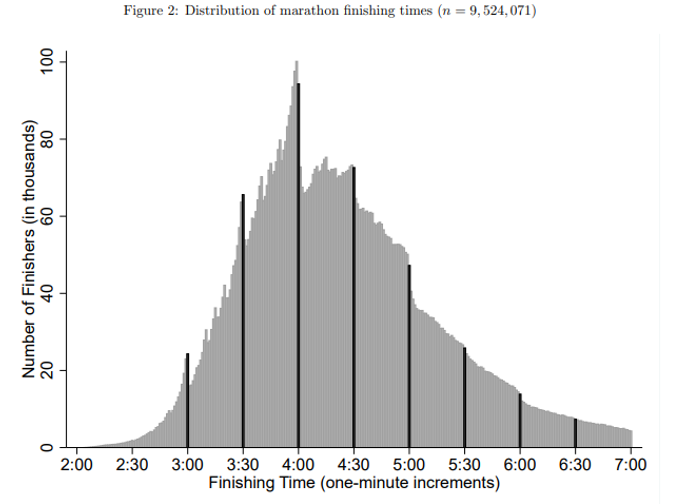
Another intriguing study of over nine million marathon times from amateur athletes (Allen et al., 2016) confirms this theory. The data shows an unusually sharp increase in finishers just before every marathon time barrier (3 hours, 4 hours, 5 hours). A decrease in running speed is inherent to the marathon, but with a specific goal in sight, many athletes seem able to accelerate again over the final kilometers. A fascinating detail of the study: of the sub-3-hour finishers, only 30% were able to accelerate over the last two kilometers, whereas 35% of the 4-hour finishers and even 40% of the 5-hour finishers were able to run the final two kilometers faster than the preceding ones. It appears that the brains of better-trained athletes already have a more finely calibrated understanding of their own performance capabilities, thus leaving less in reserve for the final kilometers.
The Central Governor Model and Its Limitations
Noakes's assumption that fatigue originates in the brain and that an athlete's mental state is largely responsible for their performance is undisputed from today's perspective. However, a clear answer as to how fatigue is actually controlled, what share the physiological systems have in actual performance compared to the brain, and what ultimately prevents us from running faster, remains elusive.
Because Noakes's theory also has logical gaps, or rather, there are practical examples that are very difficult or impossible to reconcile with his theory. How is it possible that runners sustain injuries like torn muscle fibers during training? Why can tendons tear during strength training if the brain is supposedly responsible for protecting the body?
Another phenomenon that is difficult to explain with the CGM is heat collapse. Many athletes only experience this after crossing the finish line, but there are also examples of athletes who collapsed before the finish line and were unable to continue running. Be it triathlete Sarah True at the 2019 Ironman in Frankfurt, who collapsed while leading on the last kilometer of the marathon and could not finish the race. Or Taylor Knibb at the 2025 Ironman in Hawaii, also leading, who collapsed on the highway and had to abandon the race. Why didn't the Central Governor intervene here to protect the athletes from a serious crash?
Was their motivation stronger than the Central Governor?
That is what we will explore in the third part of this series Pushing the Limits - The Conscious Quitter...
References
Allen, E. J., Dechow, P. M., Pope, D. G., & Wu, G. (2016). Reference-Dependent Preferences: Evidence from Marathon Runners. Management Science.
Cabanac, M. (1986). Money versus pain: Experimental study of a conflict in humans. Journal of the Experimental Analysis of Behavior.
Hutchinson, A. (2018). Endure: Mind, Body, and the Curiously Elastic Limits of Human Performance. William Collins.
Noakes, T. D. (2012). Fatigue is a brain-derived emotion that regulates the exercise behavior to ensure the protection of whole body homeostasis. Frontiers in Physiology.
Tucker, R., Lambert, M. I., & Noakes, T. D. (2006). An analysis of pacing strategies during men's world-record performances in track athletics. International Journal of Sports Physiology and Performance.