Creatin
The game-changer for performance, glycogen replenishment, and cognitive focus in endurance sports.
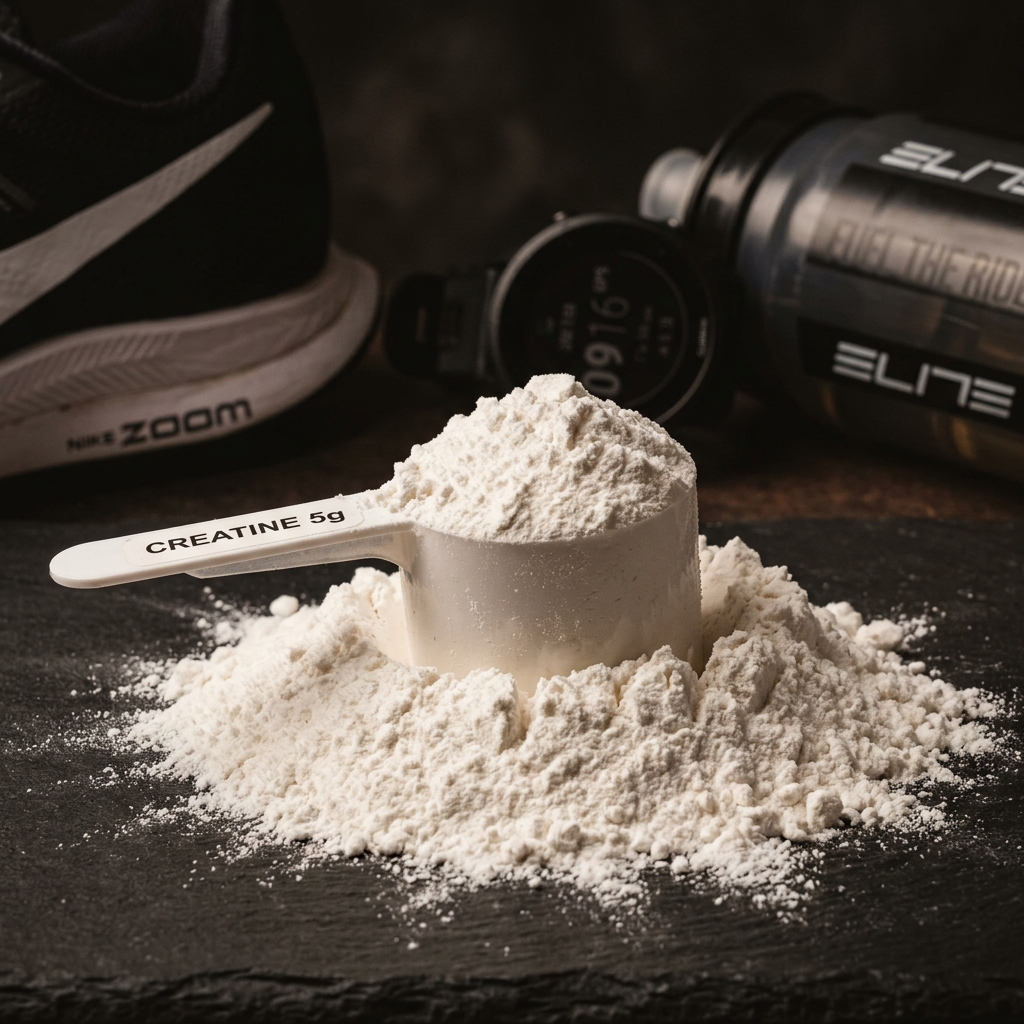
TL;DR: Creatine is not just for bodybuilders. Endurance athletes also benefit from enhanced glycogen storage, accelerated recovery, protection against muscle cell damage, and cognitive support under sleep deprivation.
In the previous installments of our "Fueling Performance" series, we established the metabolic foundation. We learned why energy availability is the master key to performance, why carbohydrates are the undisputed kings during high-intensity training, and how fats and proteins govern your recovery and health. In Part 6, we took a deep dive into blood markers to take the guesswork out of your training.
Today, we turn our attention to an ingredient that enjoys almost legendary status in sports nutrition, yet is paradoxically avoided by many endurance athletes:
Creatine.
When people think of creatine, they usually picture bodybuilders striving for maximum muscle volume. The stereotype persists: "Creatine makes you heavy, causes water retention, and is useless for endurance sports."
However, sports science paints a completely different picture. Creatine is the most thoroughly researched supplement in the world, and in endurance sports, it proves to be a true Swiss Army knife – going far beyond simple strength building.
1. The Biochemistry Simplified: The ATP Turbo
To understand why creatine is valuable for you as an endurance athlete, we must look inside the muscle cell. With every movement, your muscles consume ATP (Adenosine Triphosphate) – the body's universal energy currency.
The problem: ATP stores in the muscles are tiny and exhausted after just 2 to 3 seconds of maximal effort. To keep producing energy, the body must regenerate ATP at lightning speed. This is where creatine comes in – specifically creatine phosphate (PCr).
It donates its phosphate group to the spent ADP (Adenosine Diphosphate), creating new ATP in a fraction of a second:

This process is entirely anaerobic-alactacid (without oxygen and without lactate accumulation). Creatine is thus your ultimate emergency reserve for high-intensity bursts. When you attack on a climb, sprint for a signpost, or pick up the pace during a transition in a triathlon, your creatine stores dictate how long you can sustain this peak output before your muscles begin to fatigue.
2. The Endurance Effect: Glycogen, Thermoregulation, and Recovery
Why does a marathon runner or long-distance triathlete benefit from creatine if the race is primarily run in the aerobic zone? The answer lies in the physiological side effects of creatine saturation:
A. Glycogen Supercompensation
Carbohydrates are the limiting factor during long training sessions and races (see Part 3). Science shows that creatine can significantly enhance the storage of carbohydrates as muscle glycogen.
Studies (such as Roberts et al., 2016) show that athletes who supplemented with creatine prior to a classic carbohydrate loading phase achieved significantly higher muscle glycogen storage compared to a control group. For a long race, this simply means a larger fuel tank and a delayed onset of the dreaded "hitting the wall."
B. Cell Hydration and Thermoregulation
Creatine is an osmolyte. This means it draws water into the muscle cell (intracellularly), leading to an increase in total body water.
At first, this weight gain might sound discouraging for weight-sensitive athletes. However, this "hyper-hydration" offers significant advantages during hot races. The stored water acts as a buffer, stabilizing blood volume and improving thermoregulation. Your body can dissipate heat more effectively, your heart rate remains slightly lower at the same intensity in the heat, and the risk of dehydration decreases (Lopez et al., 2009; Antonio et al., 2021).
C. Reduction of Muscle Damage and Inflammation
Hard training breaks down muscle structures. Studies (summarized in the JISSN position stand by Kreider et al., 2017) show that taking creatine before and after intense sessions can help reduce inflammatory markers (such as TNF-alpha and IL-6) and signs of muscle damage (such as creatine kinase, discussed in Part 6). The result: a faster transition from catabolism to adaptation – in other words, enhanced recovery.
3. Mental Edge: Creatine for the Brain
An often-overlooked aspect is the effect of creatine on the central nervous system. Your brain is a major energy consumer, accounting for about 20% of your total daily energy expenditure. The ATP system plays a fundamental role here as well.
Recent research (e.g., McMorris et al., 2006) impressively demonstrates that creatine supplementation can improve cognitive performance, short-term memory, and reaction time – particularly under conditions of sleep deprivation and mental fatigue.
For ultra-endurance athletes (e.g., in ultra-trails or 24-hour bike races), as well as busy professionals who still have to complete a hard interval session after a demanding day at work, this is a massive lever. Creatine helps you maintain mental focus, delay fatigue signals from the brain (central nervous system fatigue), and make precise decisions when your body wants to quit.
4. Usage in Practice: Protocol and Quality Check
How do you integrate creatine into your daily training routine?
Choosing the Product
Forget expensive and exotic forms of creatine like creatine HCL, buffered creatine (Kre-Alkalyn), or creatine ethyl ester. Numerous studies prove that these forms are neither better absorbed nor more effective. They are simply more expensive.
The absolute gold standard remains creatine monohydrate. When buying, look for the Creapure® seal. This is a highly pure creatine monohydrate manufactured in Germany, guaranteed to be free from impurities (such as dicyandiamide or dihydrotriazine).
The Dosing Protocol
There are two proven ways to saturate creatine stores in the muscle:
Daily Maintenance (Recommended): You take 3 to 5 grams of creatine monohydrate daily. Saturation of the stores is reached after about 3 to 4 weeks. This method is extremely well-tolerated and easy to integrate into daily life.
Loading Phase (Fast Method): You take 20 grams daily for 5 to 7 days (split into 4 portions of 5 grams), followed by a maintenance dose of 3 to 5 grams daily. This leads to rapid saturation within a few days, but may cause mild gastrointestinal discomfort in sensitive individuals.
Pro Tip on Timing: Creatine uptake into the muscle cell is insulin-dependent. Therefore, ideally take your creatine with a source of carbohydrates and protein (e.g., in your post-workout shake or directly with a main meal). On non-training days, the timing is secondary – consistency is key.
5. Myth-Busters: What is Actually True?
Many myths surround creatine, all of which can be scientifically debunked:
Myth 1: Creatine damages the kidneys. In healthy individuals, there is no evidence of kidney damage, even with years of use. Important for your blood work check (Part 6): Since creatine is broken down into creatinine in the body, creatinine levels in blood tests may be slightly elevated. A doctor untrained in sports medicine might interpret this as kidney dysfunction. To be safe, the marker Cystatin C should be measured, which indicates true kidney function independent of creatine intake.
Myth 2: Creatine makes you bloated and fat. Yes, creatine usually leads to a weight gain of 1 to 2 kg. However, this water is stored exclusively intracellularly (inside the muscle cell), not under the skin (extracellularly). You won't look "bloated" or puffy; instead, your muscles will look fuller and more defined. For endurance athletes, this slight weight gain is almost always negligible compared to the benefits in energy supply and hydration.
Conclusion: Your Legal Performance Buffer
Creatine is not a miracle cure that will make you a pro overnight. But it is a highly effective, extremely safe, and cost-effective tool to improve your training quality, expand your energy stores, accelerate your recovery, and sharpen your mental focus.
Say goodbye to the old bodybuilding stereotypes. If you want to take your training to the next level, 3 to 5 grams of creatine monohydrate (Creapure®) daily should be a core pillar of your supplement foundation.
References
Antonio, J., et al. (2021). Common questions and misconceptions about creatine supplementation: what does the scientific evidence really show? Journal of the International Society of Sports Nutrition.
Kreider, R. B., et al. (2017). International Society of Sports Nutrition position stand: safety and efficacy of creatine supplementation in exercise, sport, and medicine. Journal of the International Society of Sports Nutrition.
McMorris, T., et al. (2006). Effect of creatine supplementation and sleep deprivation, with mild exercise, on cognitive and psychomotor performance, individual state, and plasma concentrations of catecholamines and cortisol. Psychopharmacology.
Lopez, R. M., et al. (2009). Does creatine supplementation hinder exercise performance or hydration status in hot and humid conditions? A systematic review. Journal of Athletic Training.
Roberts, P. A., et al. (2016). Creatine ingestion augments dietary carbohydrate induced muscle glycogen supercompensation during the initial 24 h of recovery following prolonged exhaustive exercise in humans. Amino Acids.